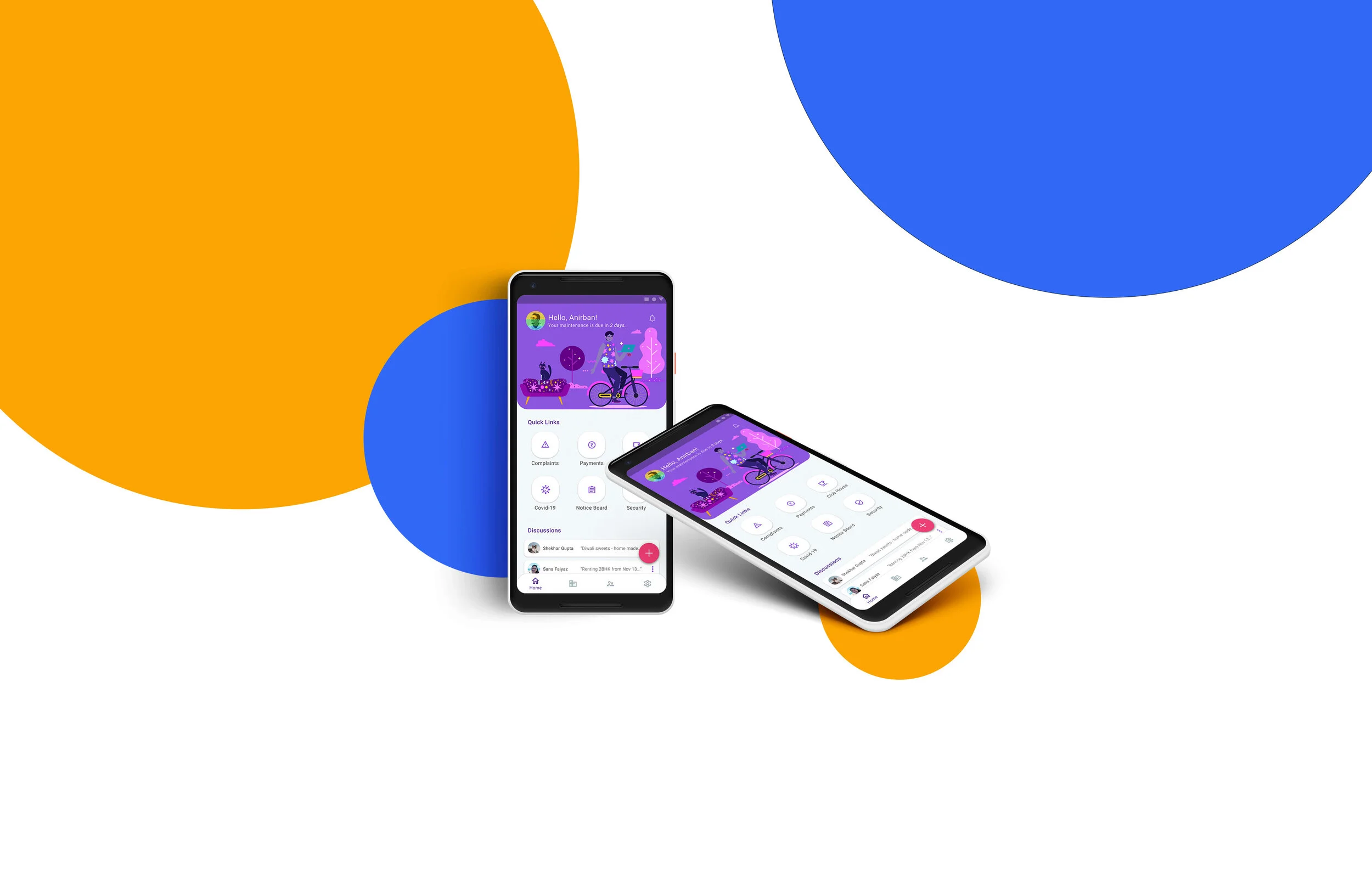
Google Design Challenge
Problem Statement
A great residential community (e.g. condominium, college dormitory, etc.) provides a variety of amenities and a dedicated staff responsible for its maintenance. But there isn’t always an easy way for community members to report problems to management so they can be resolved quickly.
Design
Design a system for a community of your choice, so members can report issues and track their resolutions.
Process
Show your process and how you arrived at your solution. Please include a sequence of high-fidelity mocks from your design solution.
Expanding the issue
I took the liberty to make a few assumptions about the current users, validate them through research and situate the problem space in a recognisable socio-economic milieu. Additionally, I presented my thought-process through a series of illustrated flows and mindmaps.
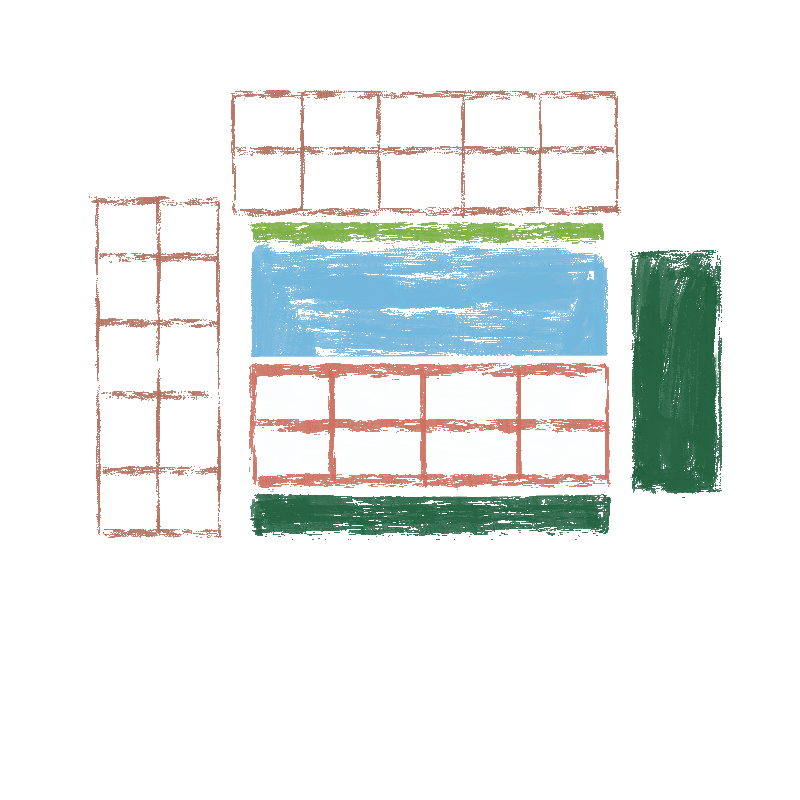
Project Name: Sobha Dream Acres
Project Location: Hebbal, Bengaluru, India
Total Land Area: 50 Acres
No. of Units: 3000 Apartments (Approx.)
No. Of Blocks: 25 Blocks
No. Of Floors: 2B + G + 14 Floors
Unit Variants: 1 BHK & 2 BHK *RERA Registered
Amenities: 4 Club Houses, 4 Swimming Pools, 2 Children's Play Area, Tennis Court, Volleyball Court, Half Basketball Court & Multiple Outdoor Sports.

No. of residents: ~ 5000
Income Group: 30-50L per unit
Age Range: 30-45 Years
Profession: IT Corporations / White-Collar / Government Sector
Home City: Outside of Karnataka
Visualising The Space
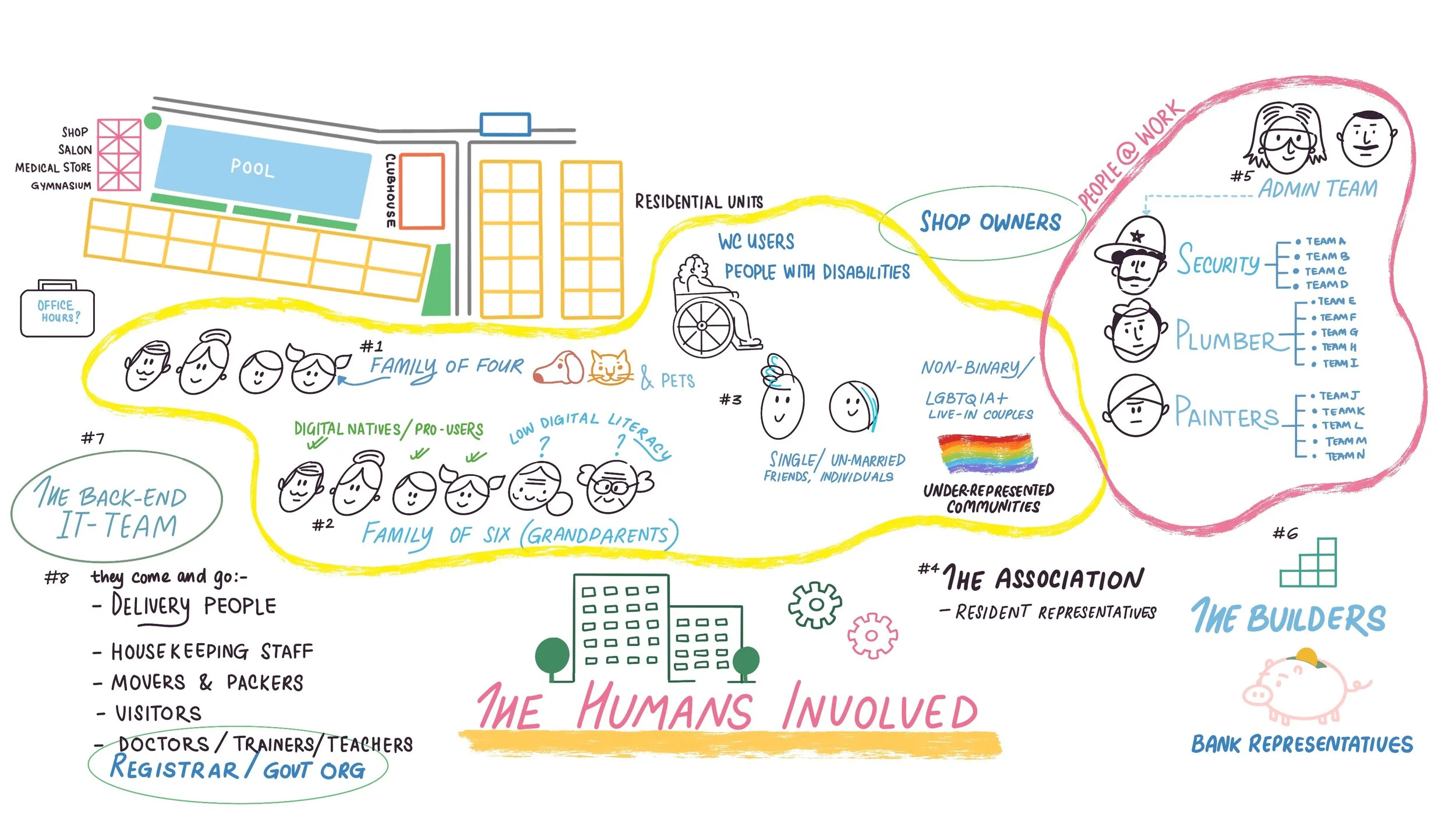
Residents: A majority of people living in these housing complexes are young (cis-het) couples with an age range of 30-45. Some are owners while some of the others are tenants. They either live as nuclear families or with parents and some of them also have children. There are also friends / colleagues who share the space and split the rent. There are people from minority communities such as religious minorities, gender and sexual minorities such as the LGBTQIA+ community, people with disabilities, wheelchair users.
Admin: There are people who work round the clock to keep this community safe and up and running: security personnels, plumbers, electricians, painters. For them this is their workspace and a source of their livelihood.
Come-and-go: These are primarily delivery agents, movers and packers, visitors and guests, doctors, fitness trainers, music teachers. This group also includes the registrars, govt. officers who come for scrutiny and auditing work; bank officials for housing loans etc. This group can also be expanded to include elected representatives from within the community of residents or homeowners. They form the “Housing Association” and control the maintenance etc.
The Humans Involved
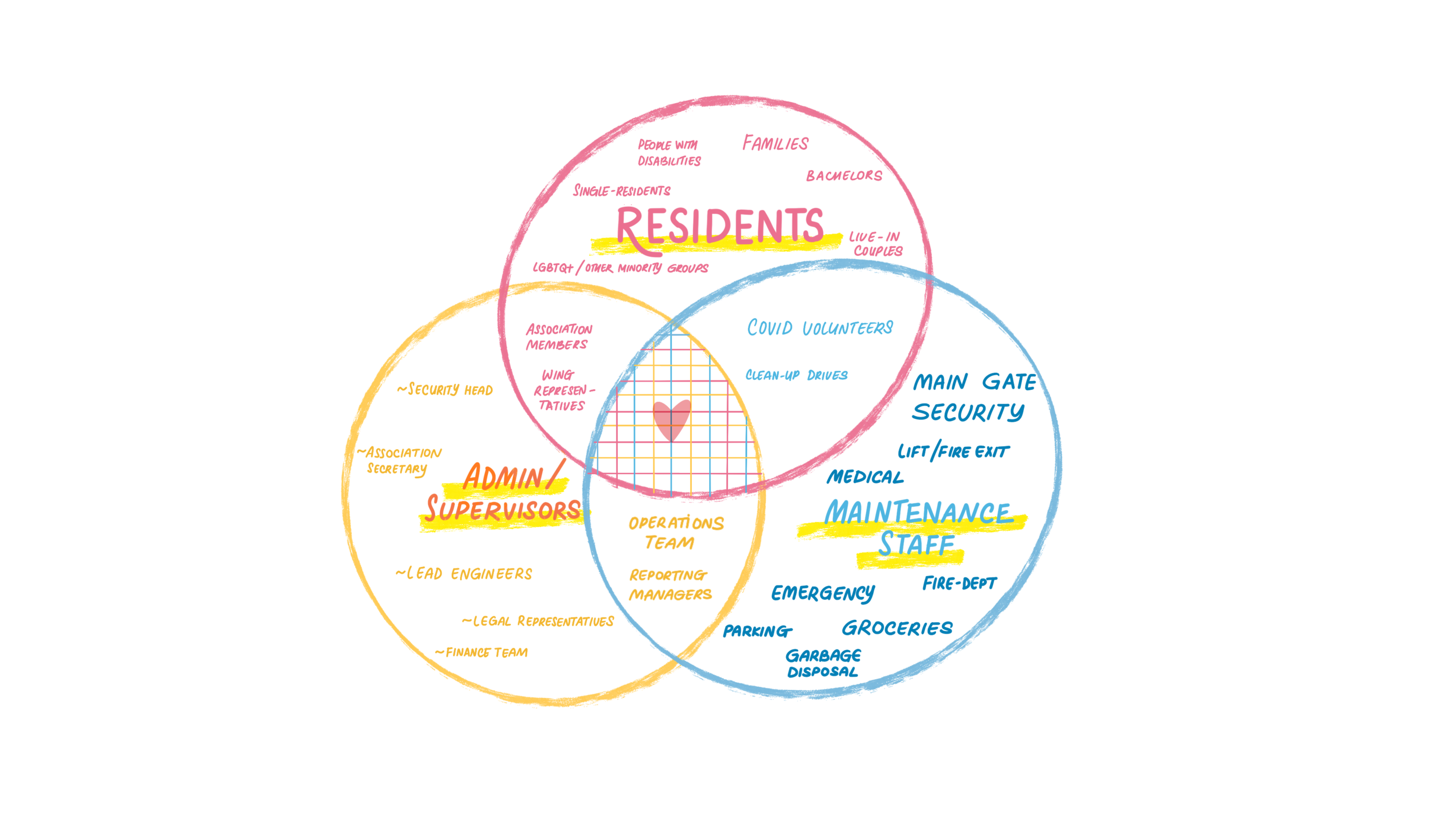
The possible solution, therefore, comes alive at the intersection of these three large groups: the residents, the admin team or supervisors (a part of whom are members of the association) and the employees of the maintenance team.
The ‘As-Is’ Solution
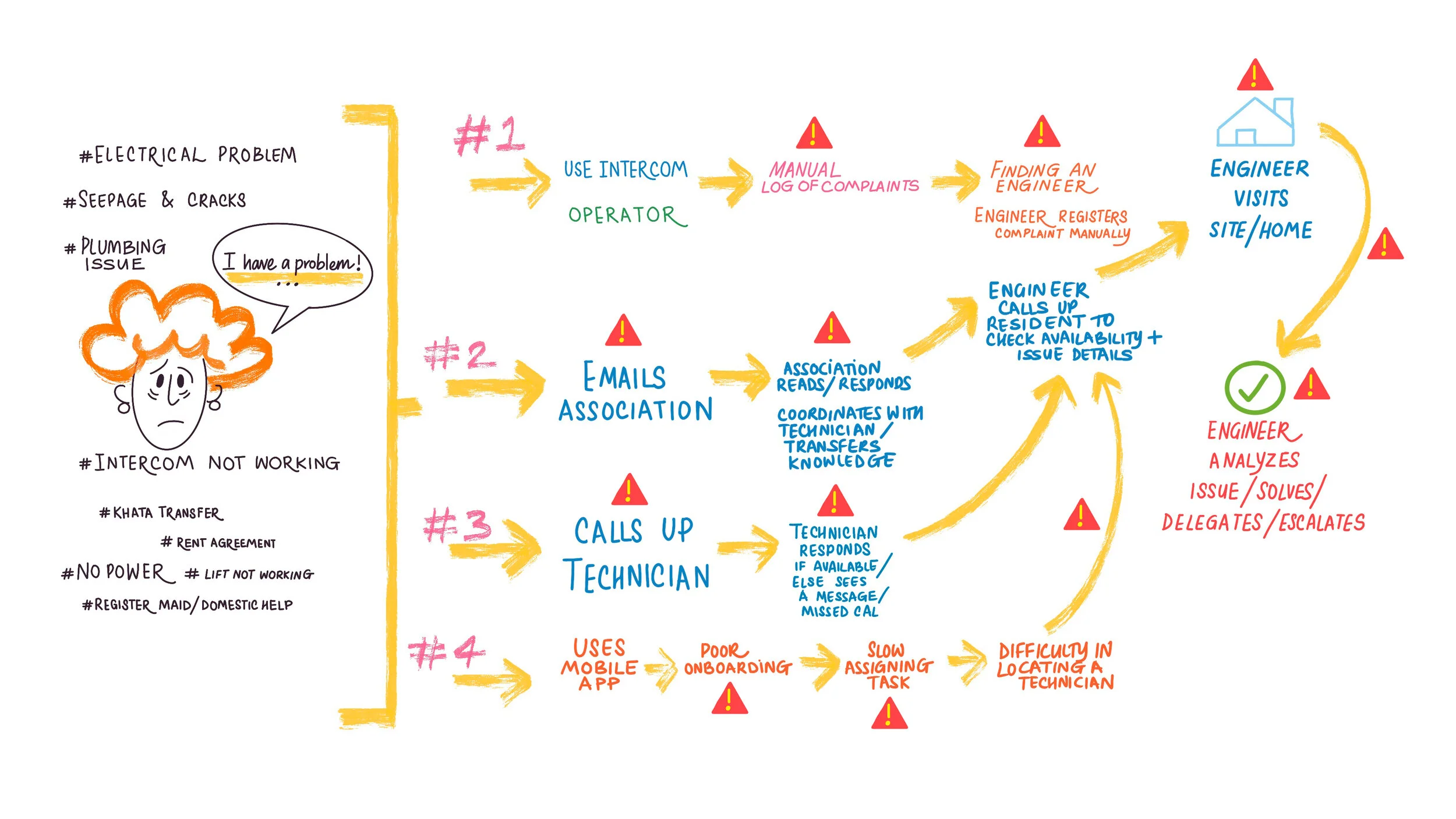
I delved deeper into the As-is scenario in which I found that a lot of residents still have not adopted an app-based approach completely. For instance, when they have an electrical problem, a seepage issue, or a power outage, they use the intercom and speak to the operator who notes down the problem and maintains a manual logbook or an excel sheet. The operator then finds an engineer or technician who is free to visit the site.
Another method of notifying is through emails that are sent to the association to report issues. The association then responds to these emails. More often than not, the residents pick up the phone and call up the technician directly as they have their numbers stored.
The research also revealed a small percentage of residents who use the apps only for entry approvals for visitors but not so much for issue tracking. They feel the experience is complicated and tedious. These traditional ways of communication and tracking issues cause delays that occur due to the communication gap among the operator, the technician, association and residents. The engineers also end up spending a lot of time answering phone-calls, running to the site and reporting back to the office.
Empathy Map
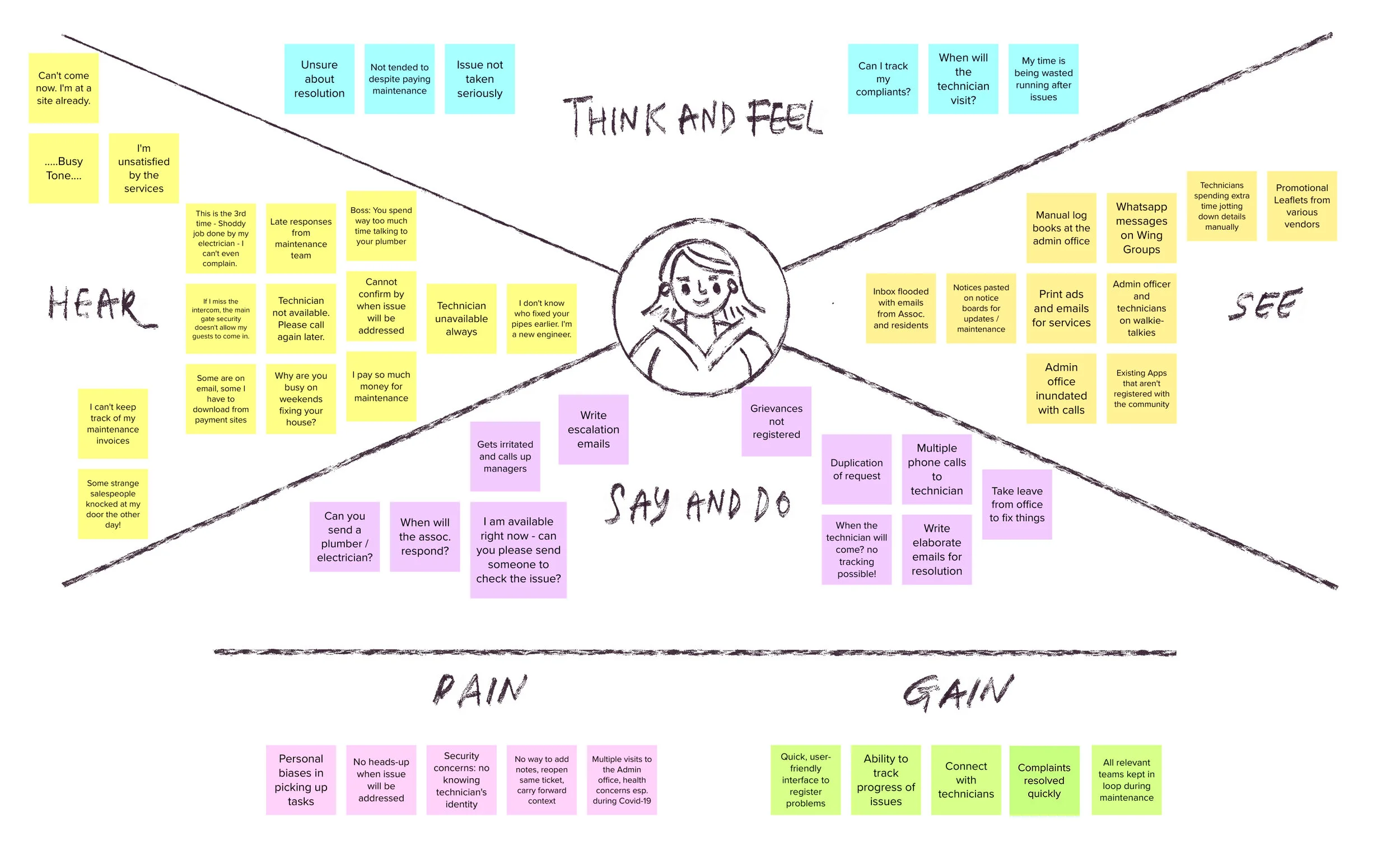
The findings encouraged me to take the next step - Empathy Mapping for such a resident. What do they hear, see, think and feel, say and do? What are the pain points and opportunities. Some of their recurring problem included the following:
They really have to keep aside time for pursuing matters on maintenance
Their weekends or some of the weekdays get taken up
There is no history maintained for the past complaints, no escalation matrix
The admin office is inundated with calls and they don’t get through the line
There is almost always a delay in technicians arriving to fix the issues
Quick Interview Insights
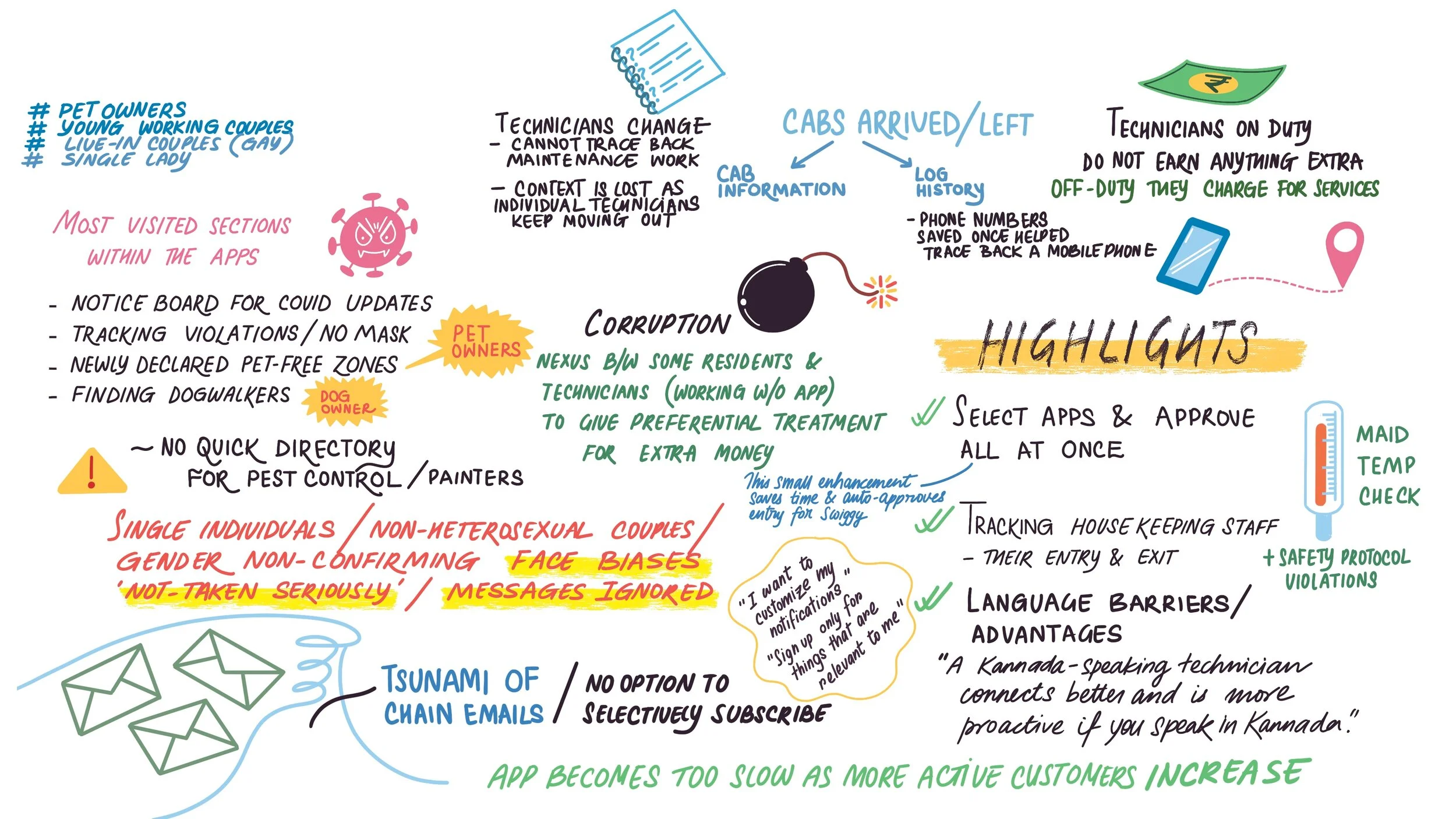
Instead of working on personas, I chose to do a few short interviews in parallel of friends and family who use apps or emails or Whatsapp groups to report and track issues. It became evident that based on personality types the hooks for engagement with the app were different. Some of them talked about tracking the Covid violations and the leaderboards that they keep checking. A few of them complained about not having a quick directory for pest control. Some spoke highly of this app called My Gate that allows you to select at one go a bunch of apps and allow permission to send in delivery people, instead of manually approving one by one.
🧟♂️
I also got a glimpse of the dark side of the ecosystem in which people who have non-conforming gender behaviour or aren’t married facing biases. During these manual complaints, admin teams and technicians don’t take their complaints seriously and do not prioritise them. It also becomes a breeding ground for corruption where some residents offer extra money to technicians tend to them early on. Language also becomes a barrier - in some cases if the resident and the admin team or technician speak the same mother tongue then they bond better and help each other out.
Due to the income / class inequality among the service providers and residents, there is a growing tendency to track and control service providers. Some residents admonish their house keeping staff if they don’t turn up for work, after seeing a notification that they have entered the complex. In addition to that their temperature checks, one-way ratings etc. points at a system that is favours the residents.
Idea Board
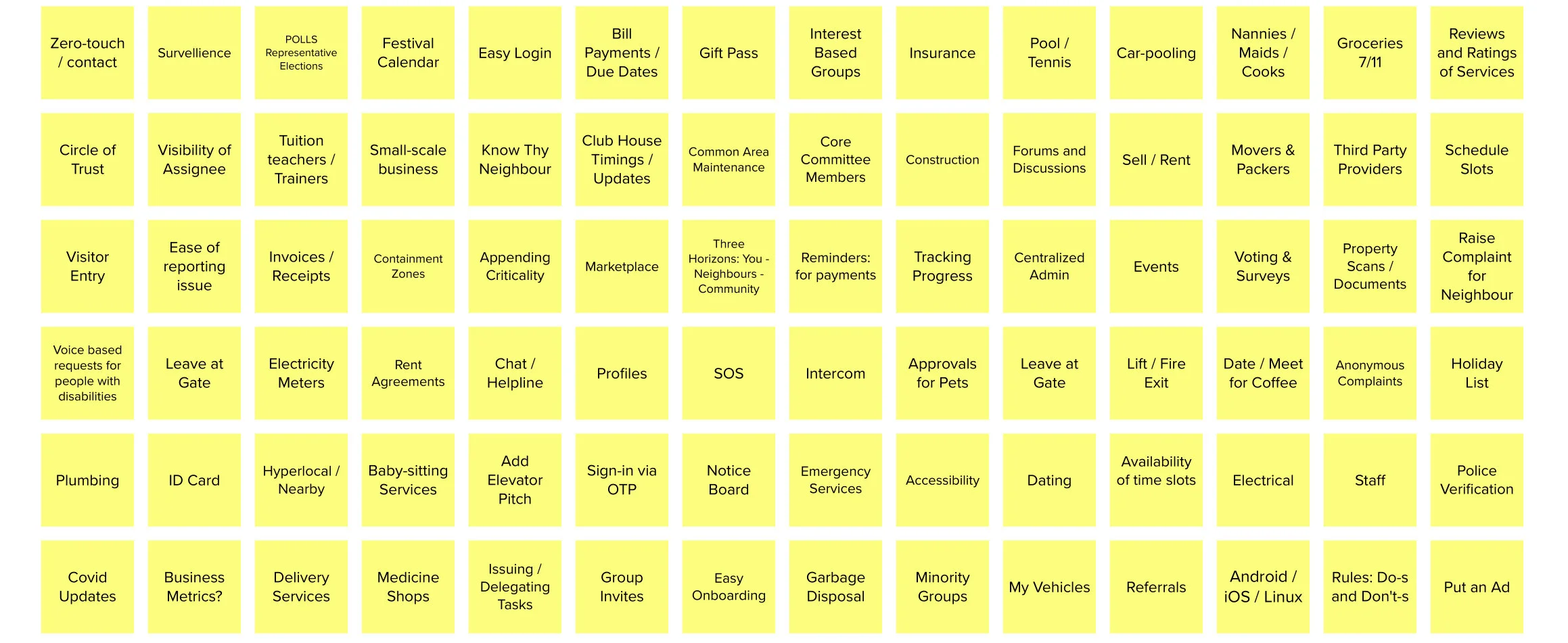
The next step was to keep these information as the bedrock and ideate without any filters: anything and everything that can be considered as a solution to this problem statement. This ranges from the basic expectations to more good-to-have features like dating within the community, hyperlocal, a dedicated chat helpline and more.
Prioritisation
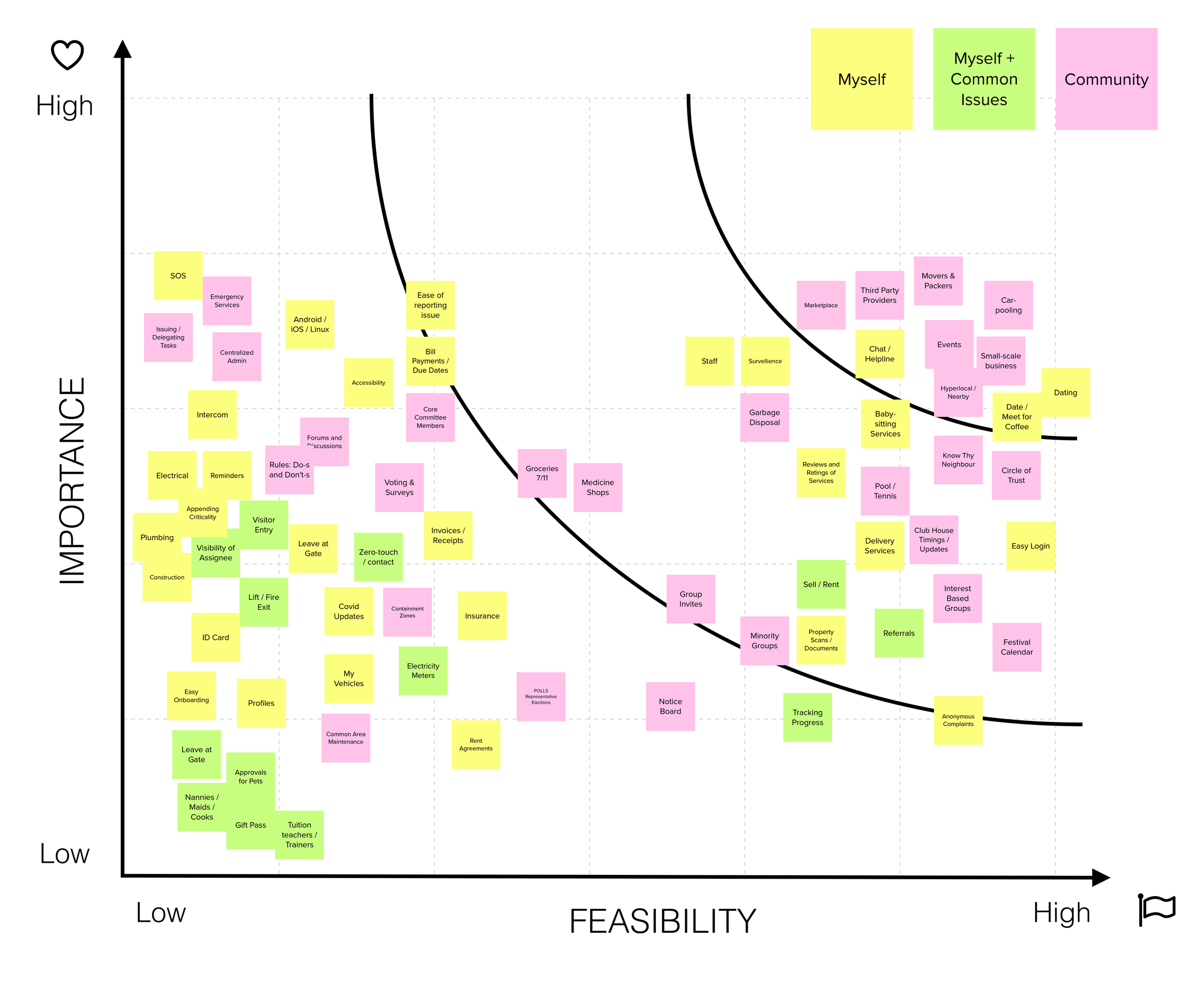
The ideas were then mapped onto an axis of importance vs feasibility of building. I also colour coded them based on individual complaints, common issues and community issues. Emergency services, electrical, plumbing, easy onboarding, leave at gate, visitor entree, visibility of assignee took up the top left quadrant.
Competitor Analysis
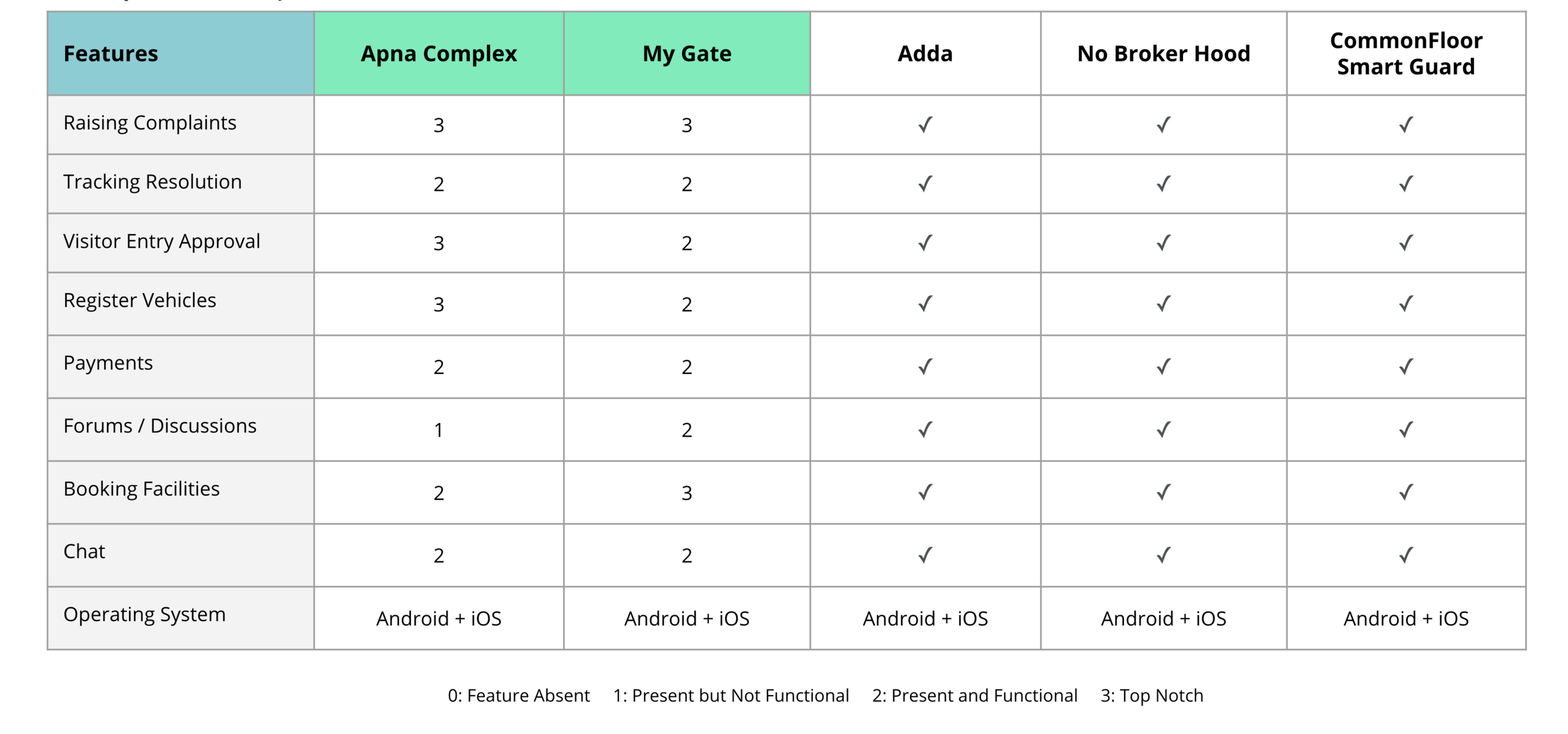
Feature Analysis of two of the apps: Apna Complex and My Gate that are quite popular among housing complexes. These apps also have large tie-ups with builders and society associations.
Assumptions
Residents are well-versed with using mobile apps and have access to high speed internet. Senior citizens and individuals with disability are assisted by family members and friends incase they face challenges in accessing mobile apps.
Maintenance is taken care of by an elected association that has representatives from the community as the General Secretary, Treasurer, Operations and Finance Head.
The builder and government officials step in only when complaints aren’t within the scope of the internal maintenance team.
Payments can be done quarterly by residents online or via cheques deposited at the finance office. Individuals complaints are not chargeable.
Scheduling / timing maintenance fixes aren’t within the scope for the first release. It can happen as a fast-follower after observing adoption and engagement.
Solution Overview
The solution considers a residential community with its staff, has an escalation matrix and a dedicated maintenance committee managed by the association. The end product would have a login system through which residents can initiate the problem registering, identify the category, add details, photo and mention whether it’s critical or not. This then goes to a centralized system that issues a ticket number, notified the relevant technician who then reaches the spot and solves the problem.
Community
Staff Distribution: security, plumbers, electricians, painters, garbage collectors, lift service team, sanitizer / medical team.
Maintenance Committee / Escalation Matrix
Community / Association Members are from the community of residents
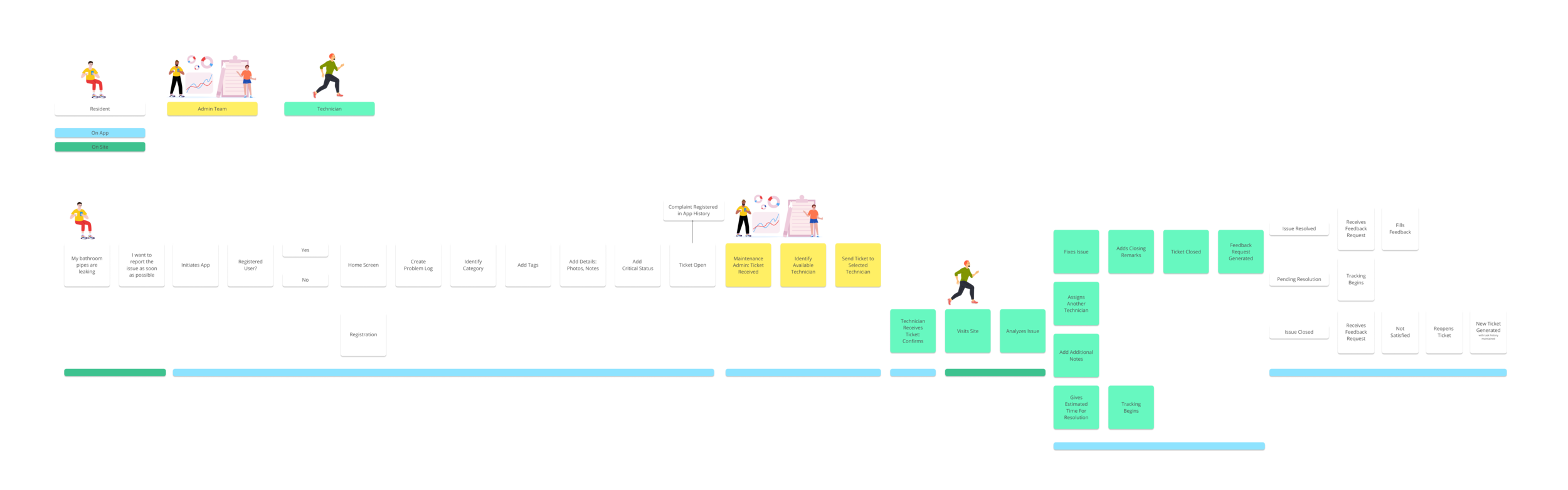
Reporting Issue
Login / Sign Up to System
Initiate Problem Log: Identify Category, add details: photos, notes, add Critical Status
Ticket open
Resolving Issue
A centralised admin system receives the open ticket request
Identifying available/relevant technician to pick up the task
Technician visits site / analyses problem and fixes problem if it can be solved right-away
For complex issues, adds notes to the same open ticket and gives estimated time for resolution
In case the issue is outside the scope of the maintenance team, a suitable suggestion is given or request forwarded to the relevant team.
Elevator Pitch
FOR (target customer)
WHO (statement of the need or opportunity)
THE (product name)
IS A (product category)
THAT (key benefit, compelling reason to use)
UNLIKE (primary competitive alternative)
OUR PRODUCT (statement of primary differentiation)
For residents in a large housing complex, who want to report and track complaints, Mi Casa is a mobile app that is a one-stop-shop for all your maintenance needs. You can now raise complaints, assign tasks, make online payments, request services, manage visitors and household help - all through a seamless and engaging experience that also guarantees top-notch data security.
User Journey Map
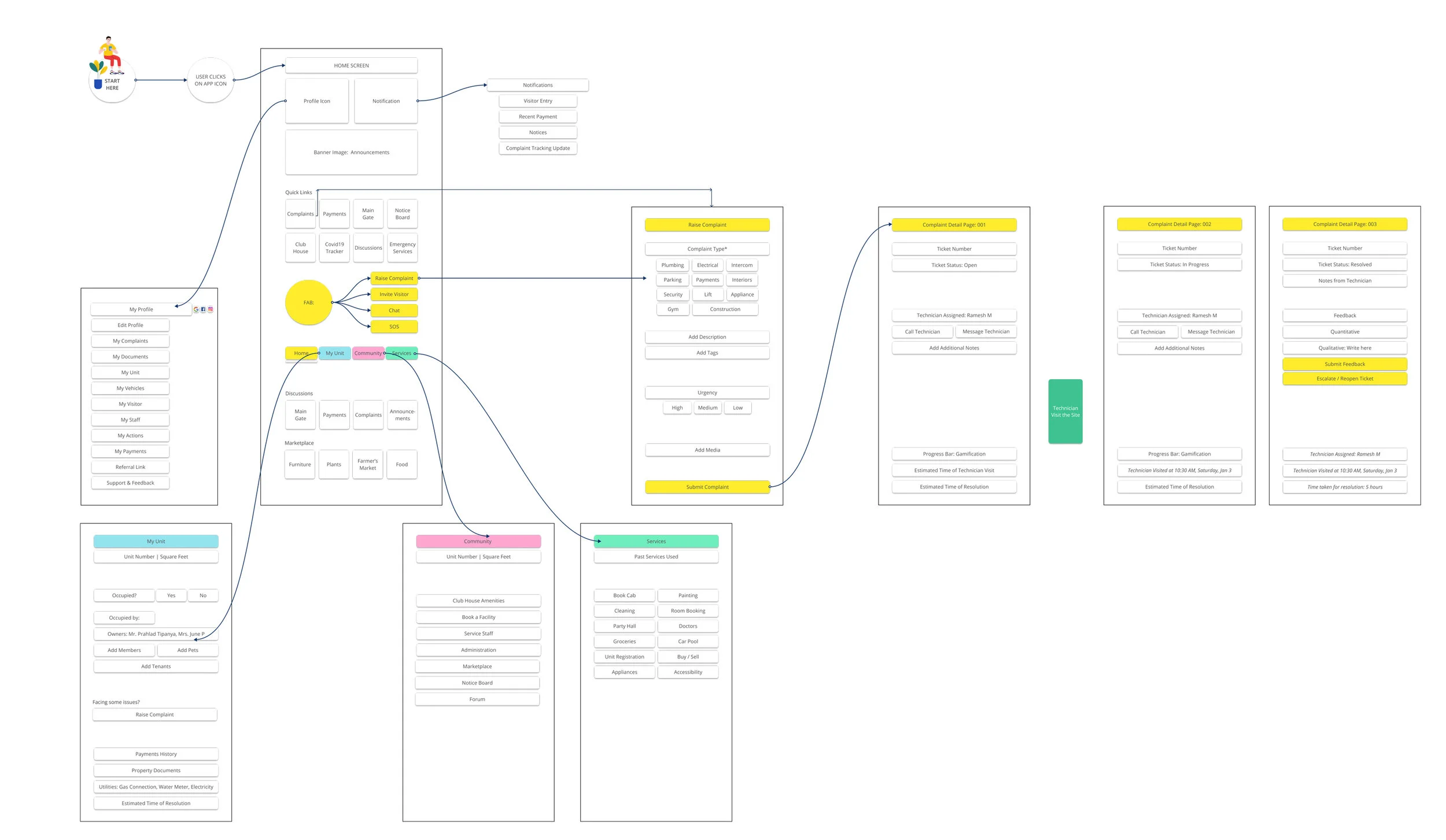
Information Architecture
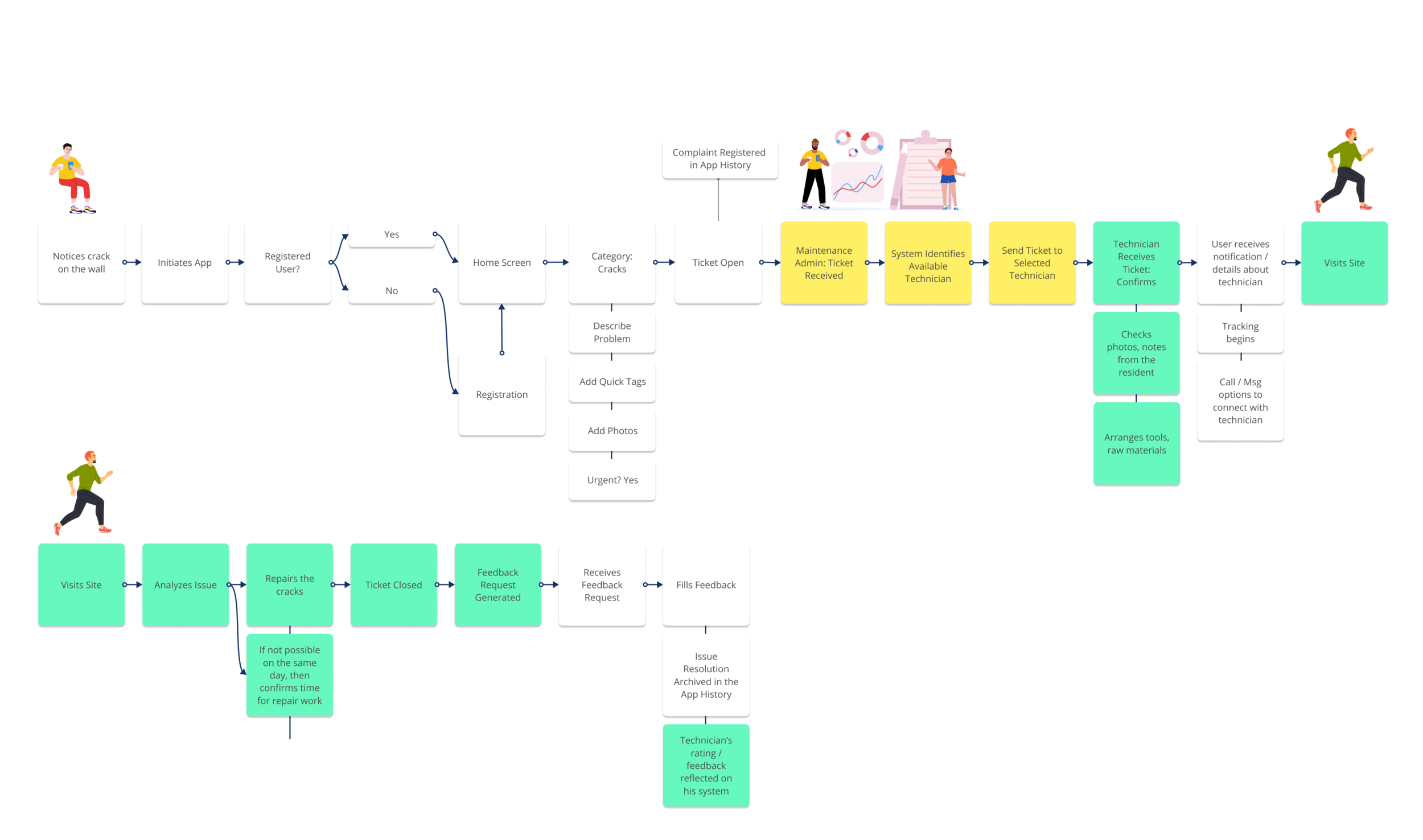
Scenario 1: Cracks in the bedroom wall
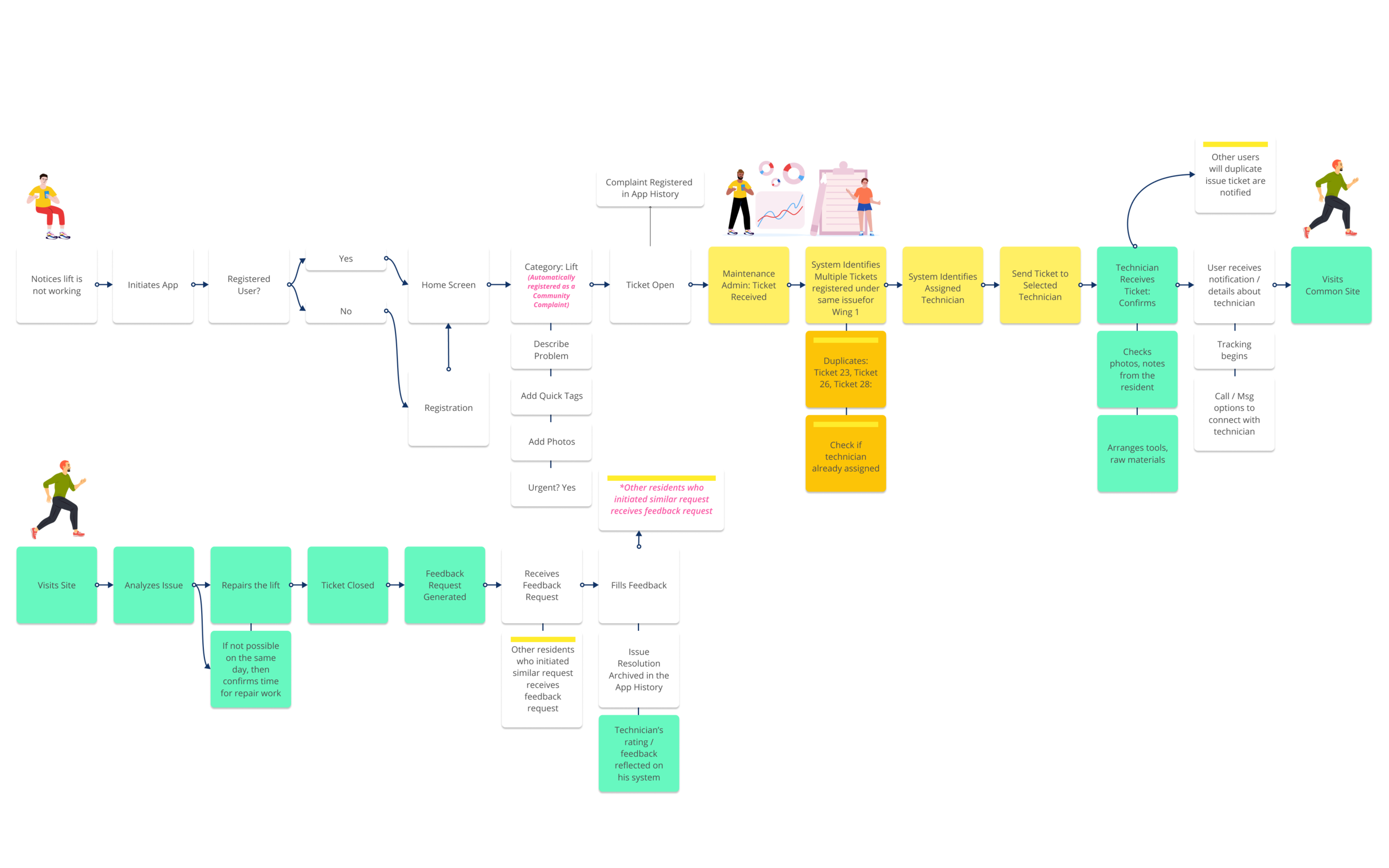
Scenario 2: Lift not working
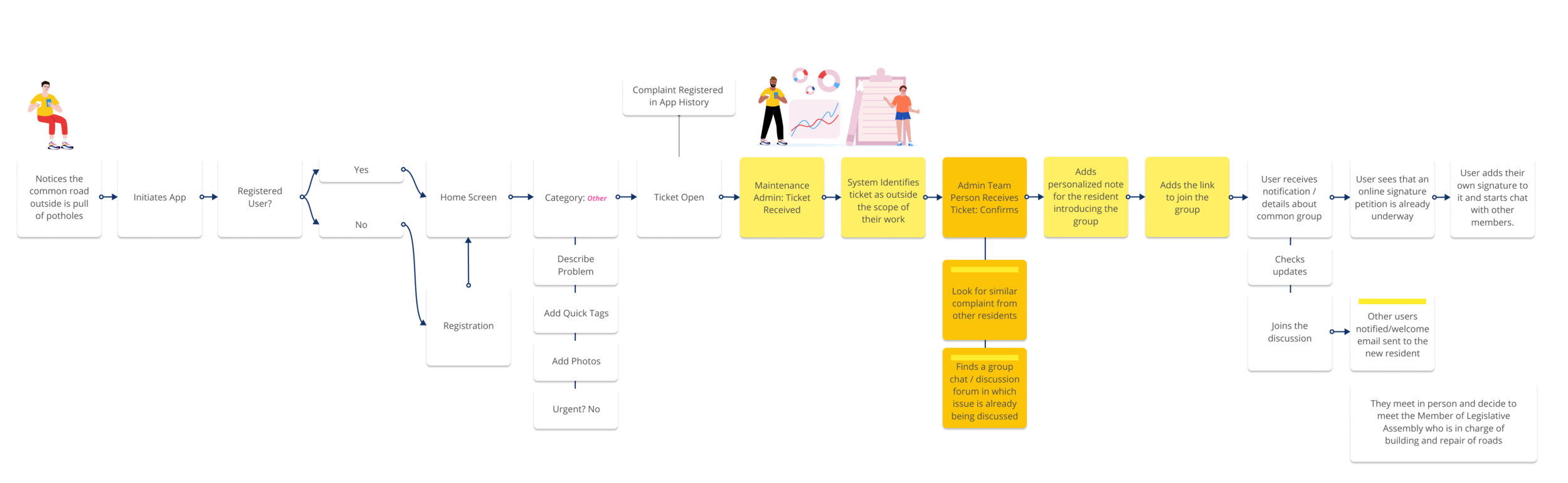
Scenario 3: Repairing main road
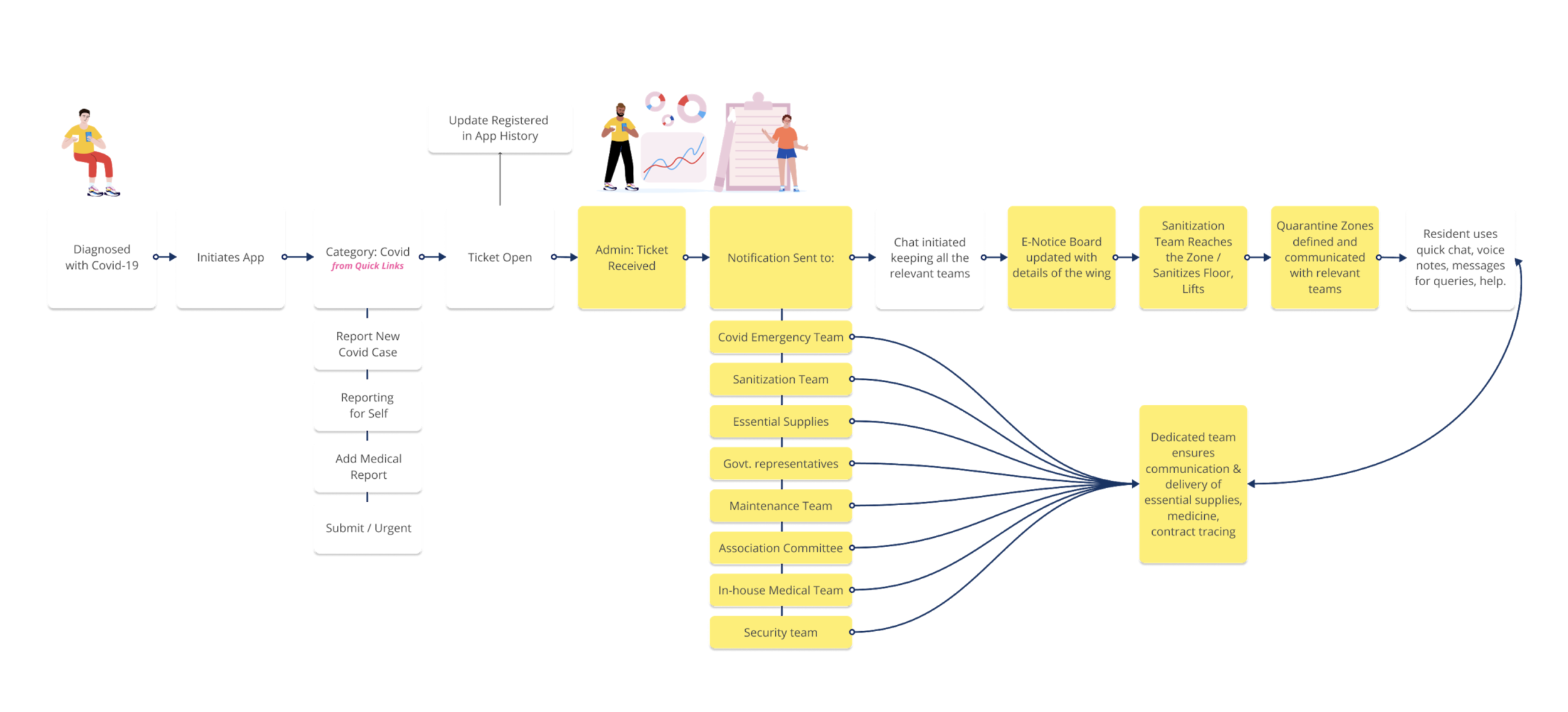
Scenario 4: Reporting Covid-19
Mi Casa
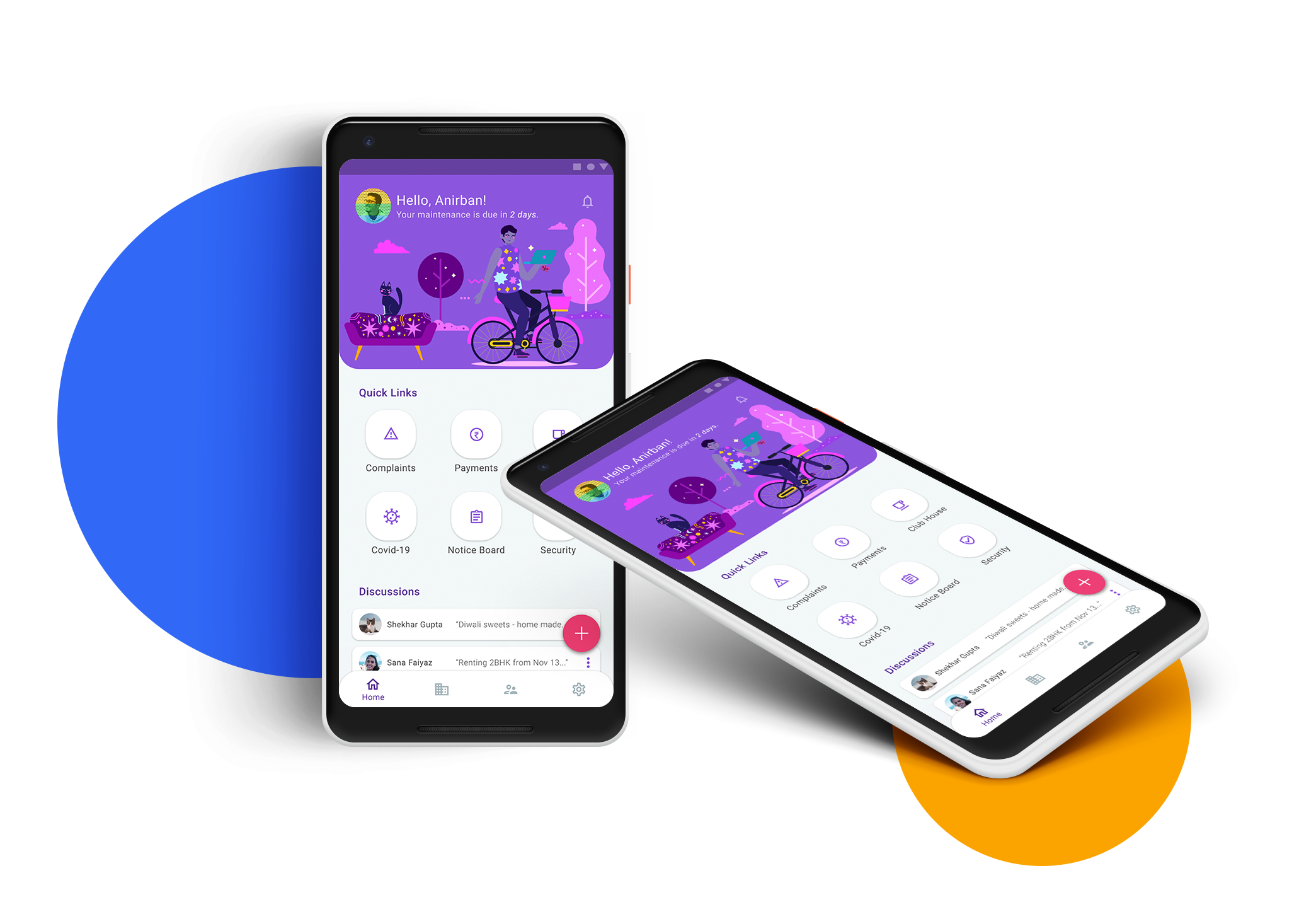
(Minimum Lovable Experience) A one-stop-shop for all your maintenance needs: raising complaints, assigning tasks, making online payments, requesting services, managing visitors and household help - all through a seamless and engaging experience that also guarantees top-notch data security.
Mockups: Low Fidelity
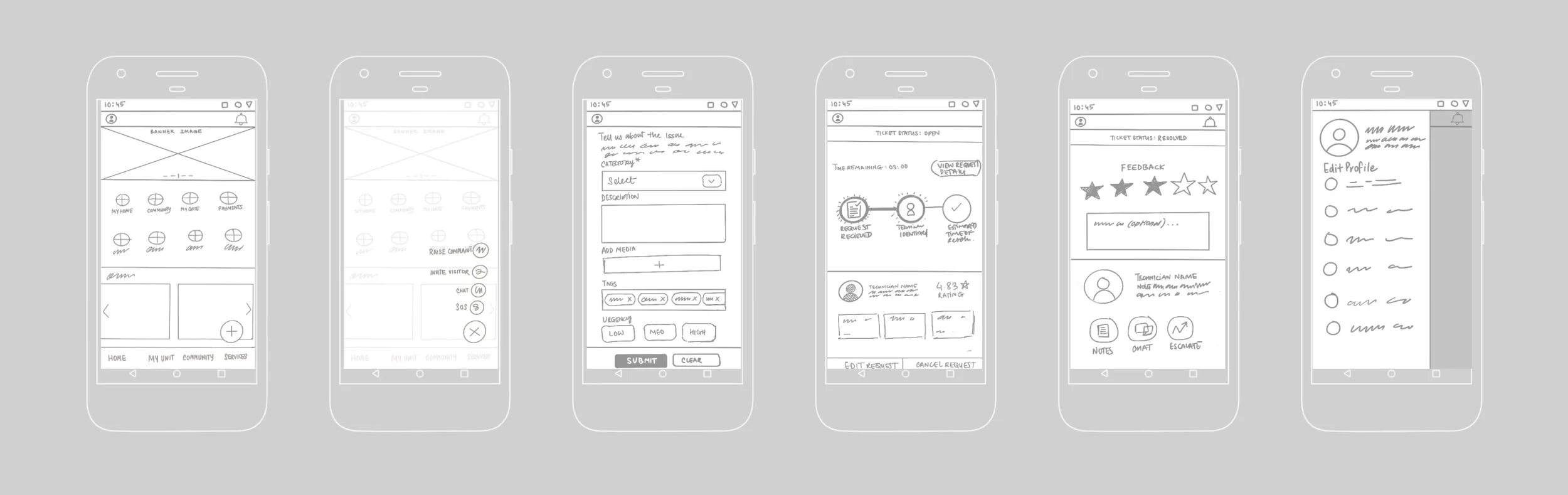
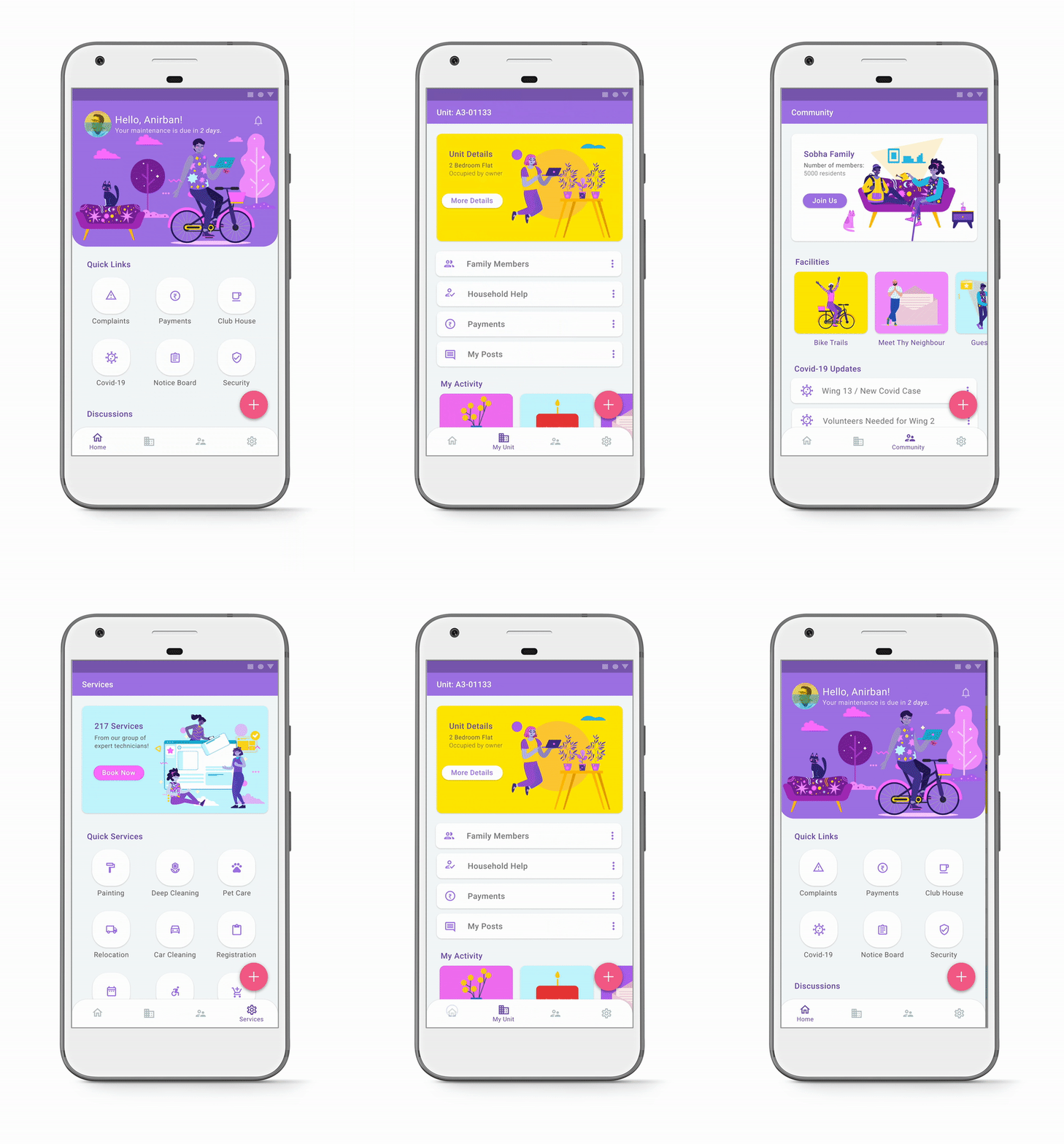
The Home page of the app has a FAB, quick links, 4 tabs, profile icon and a notification bell icon.
Once the FAB is tapped it expands into 4 options: Raise Complaint, Invite Visitor, Chat and SOS.
On tapping on Raise Complaint, the user is directed to a issue detail page that has options to choose from for Category, add issue description, add media and more.
Once the issue is registered, the tracking begins for resolution, showing the assigned technicians, their ratings, time remaining for resolution.
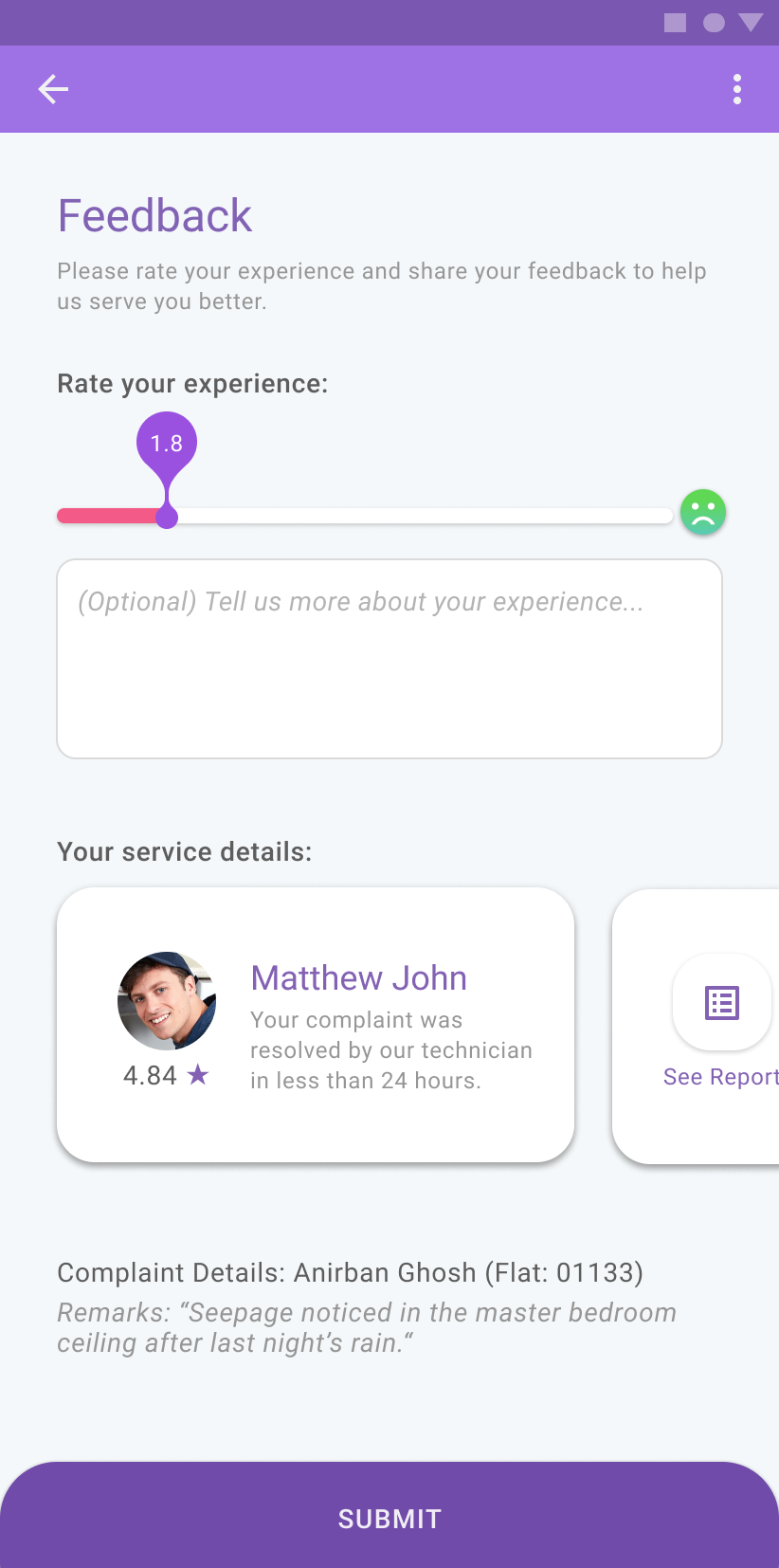
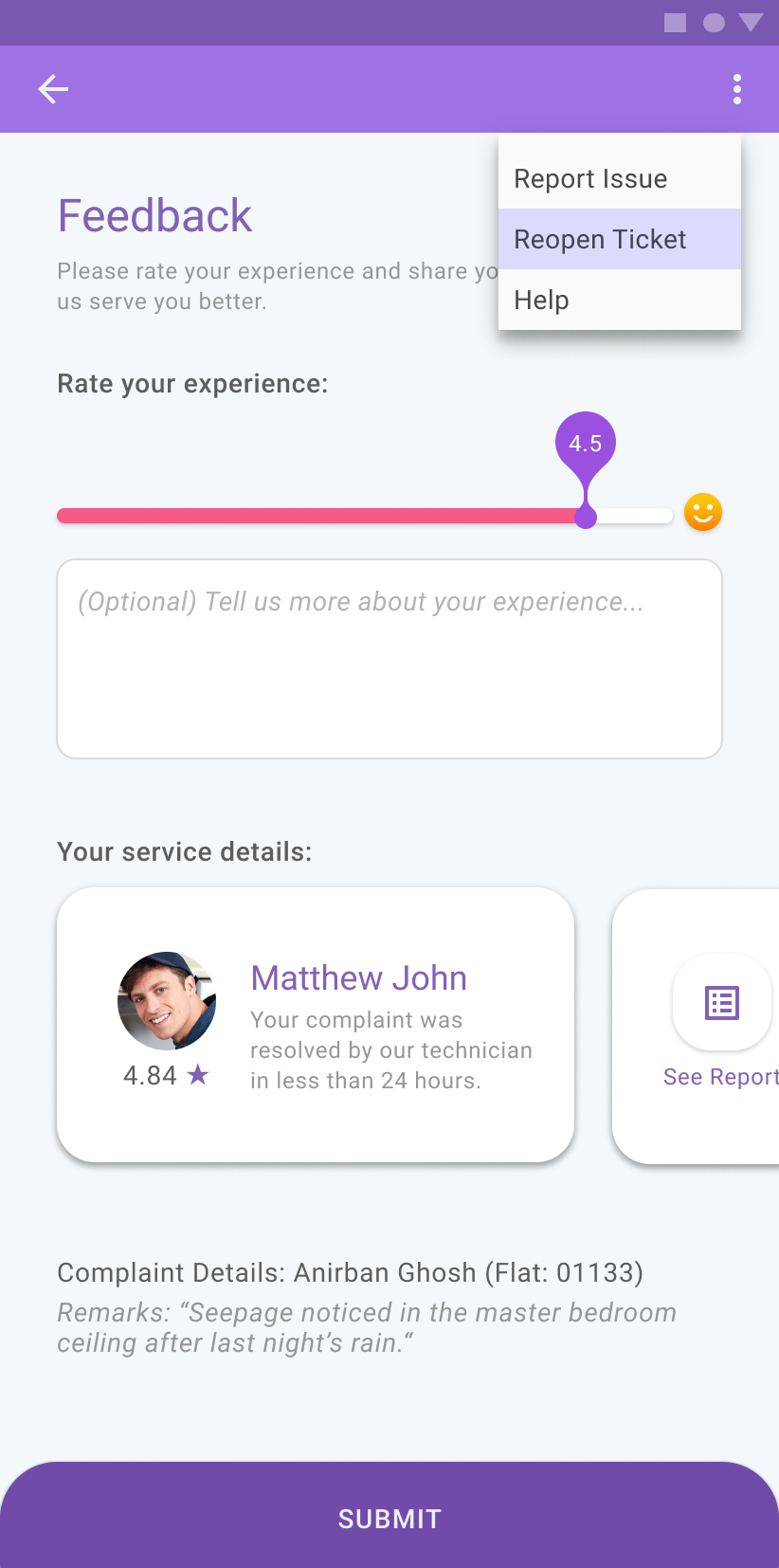
Once the issue is resolved, a feedback screen requests the user to giving a rating. The user has options for add notes, chat or escalate / reopen
the ticket.The Profile Icon accessible from the home page contains all relevant information for the user - complaint log, payments, invoices etc.
Visual Design
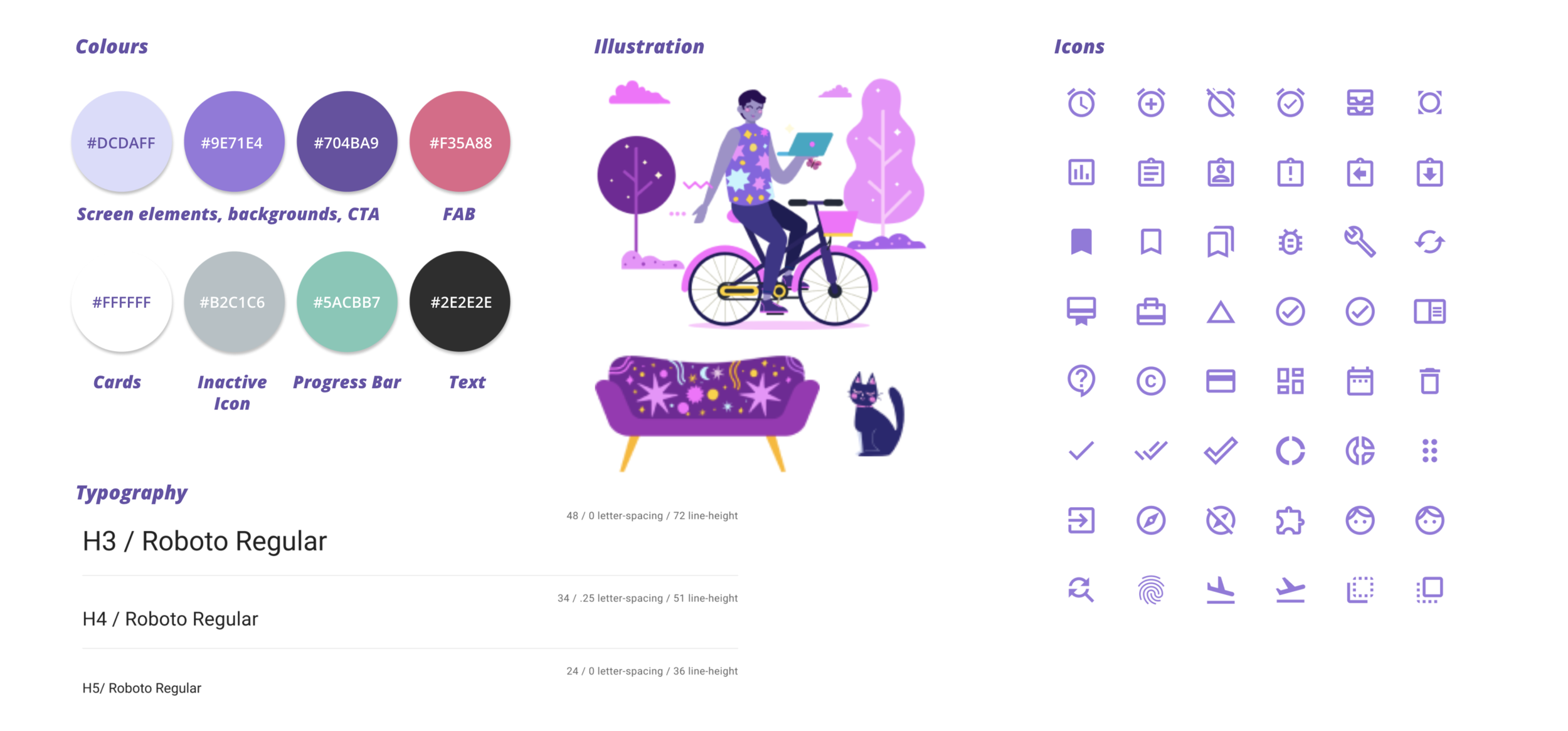
Created a vibrant colour palette that is also optimised for longer screen usage. This includes less saturated colours, illustrations that are in vogue, material design cards and icons and typography.
Loading Screens
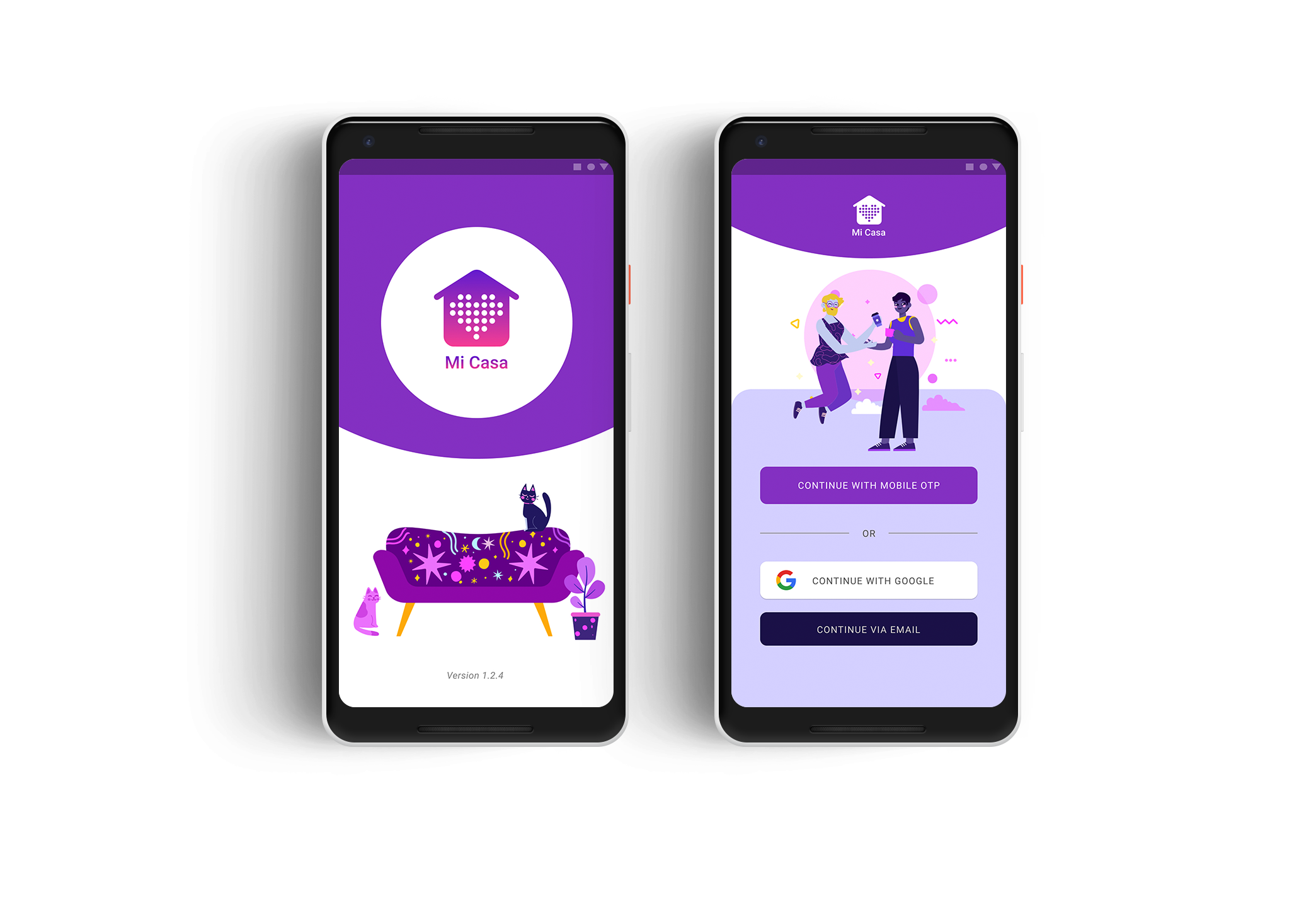
The loading and signup screens contain options to quickly register via mobile number OTP, email, social login or email.
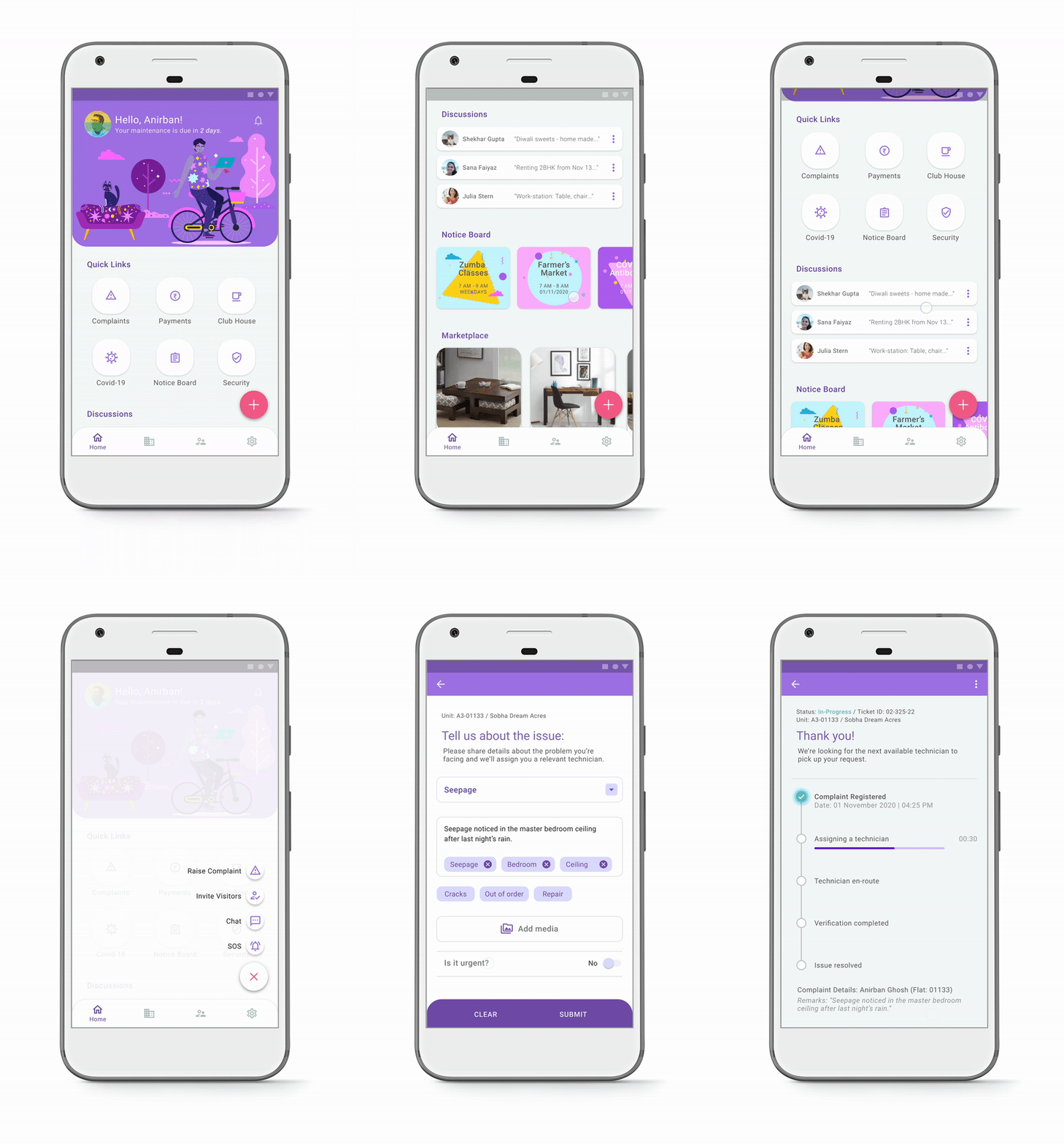
1/4 Raising Complaint
-
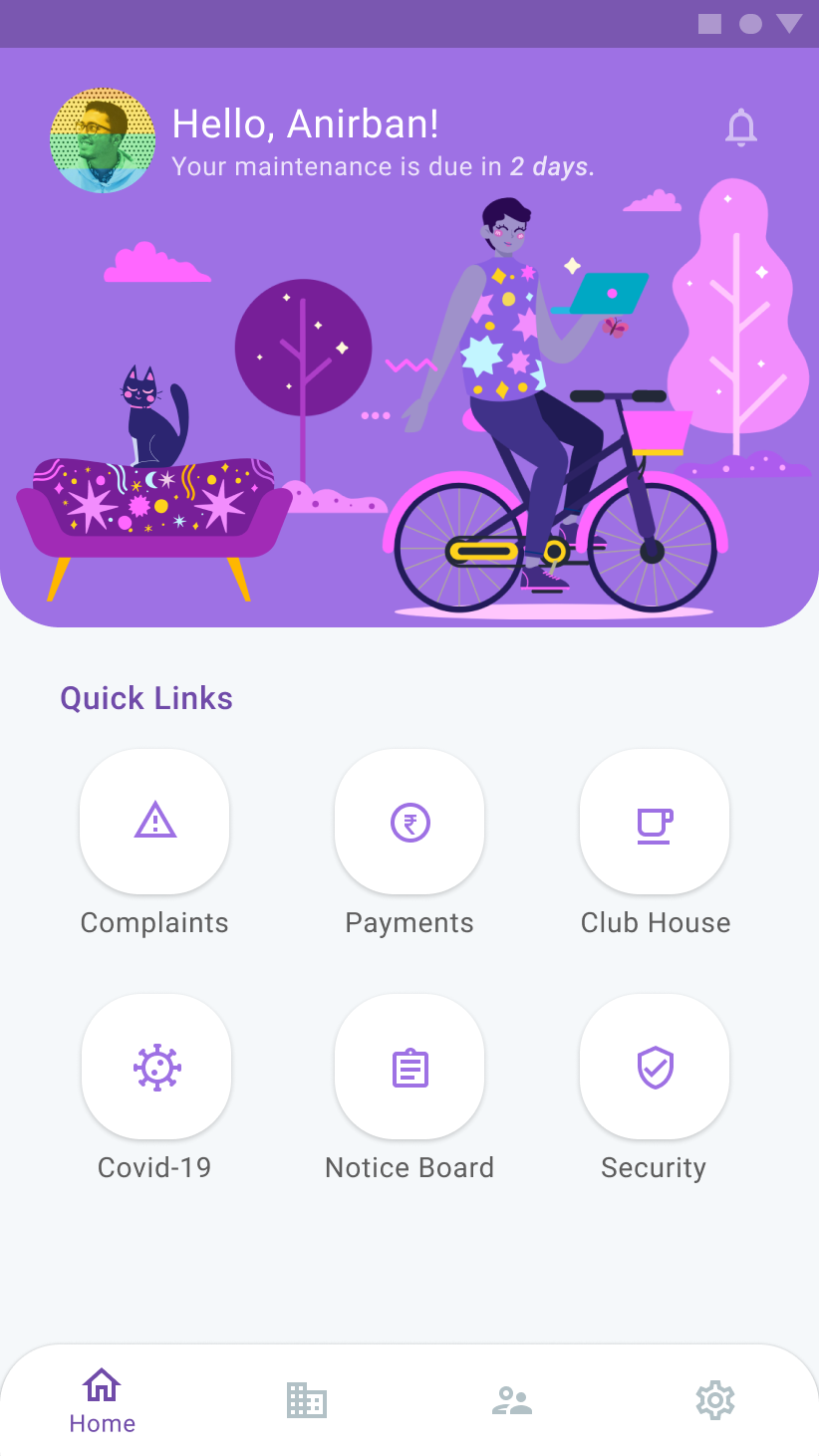
Home Page with quick links, FAB and bottom bar with tabs.
-
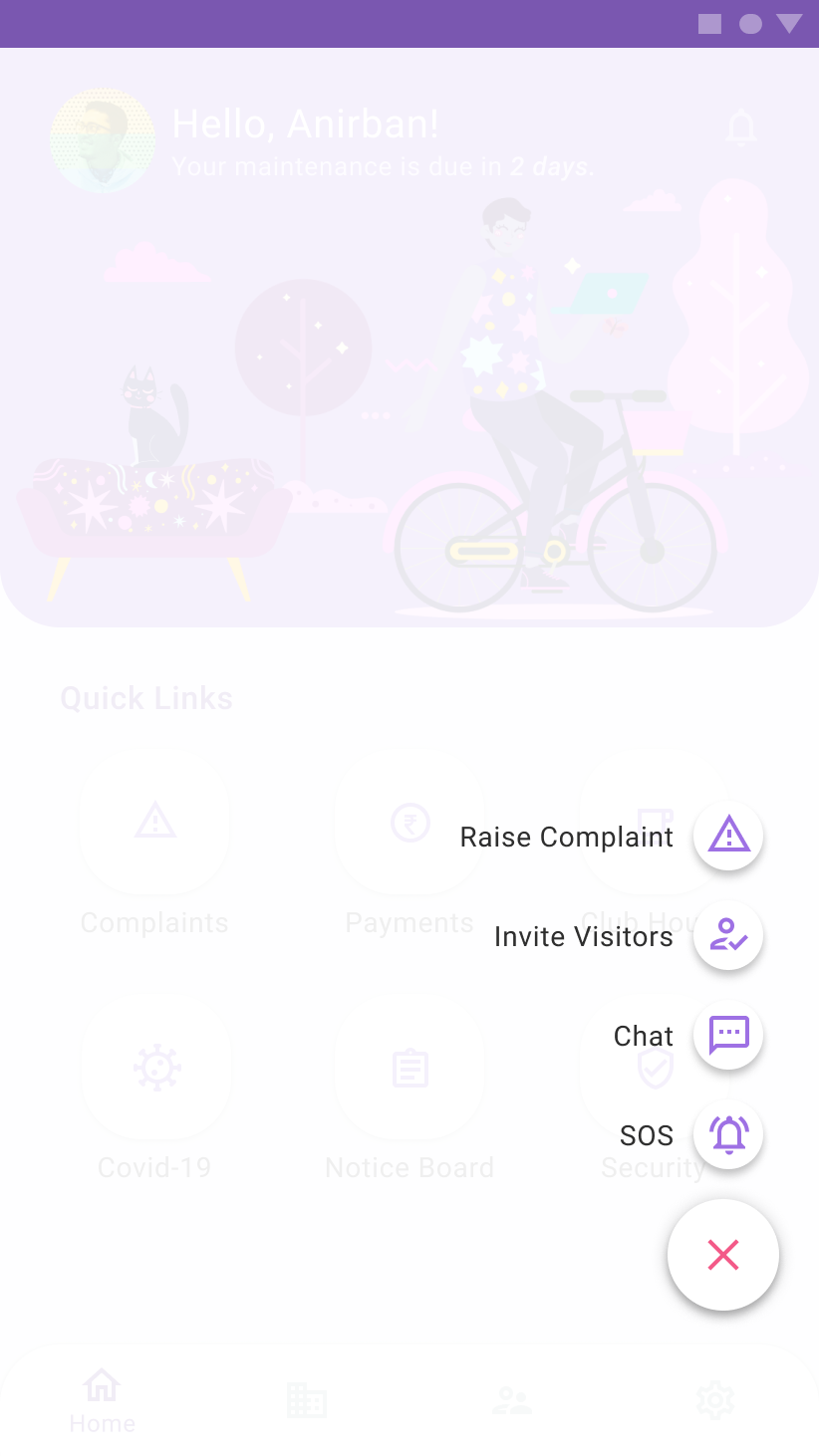
FAB opens up with quick options - Click on “Raise a Complaint”.
-
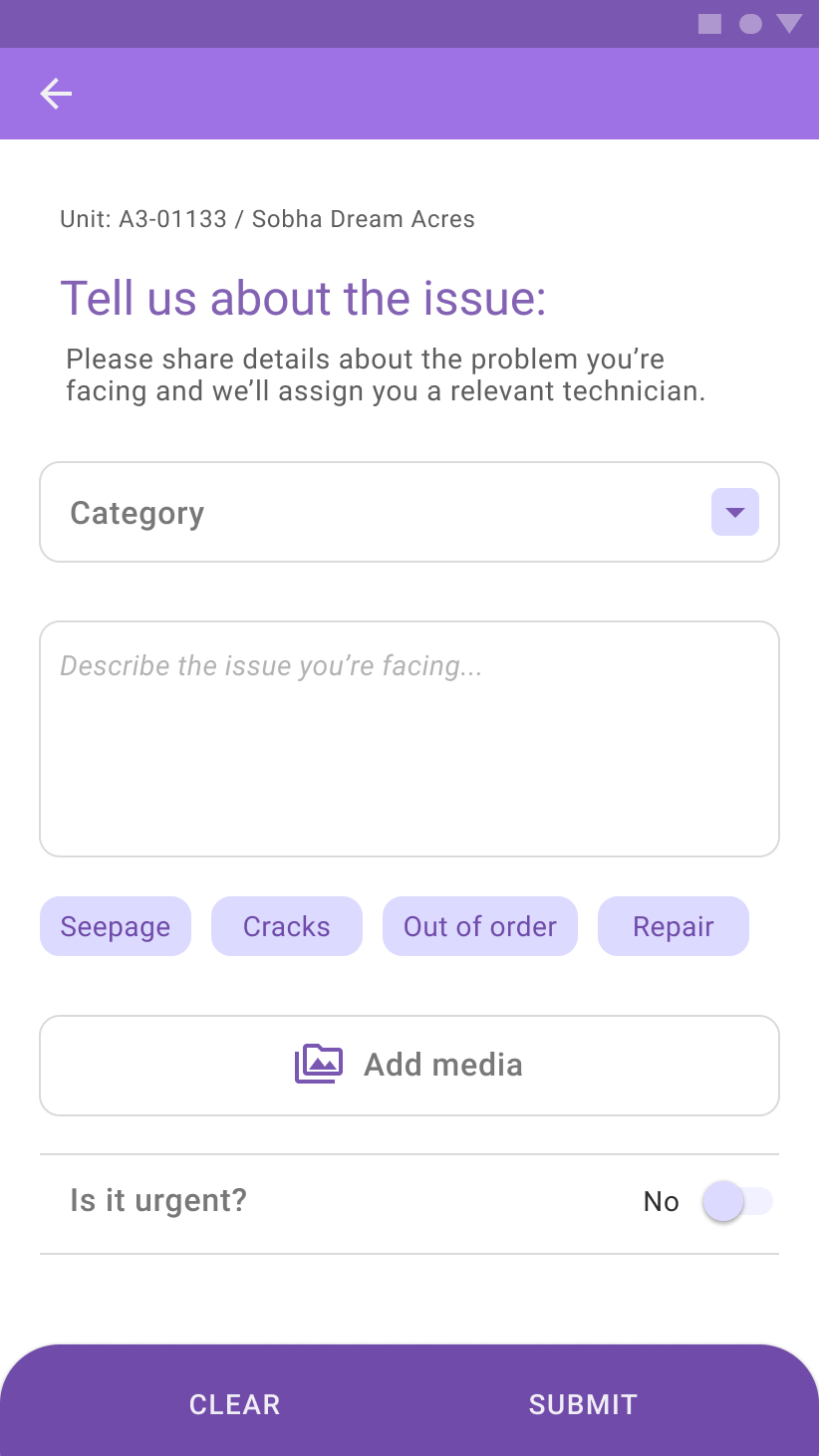
Category dropdown contains a comprehensive list of options.
-
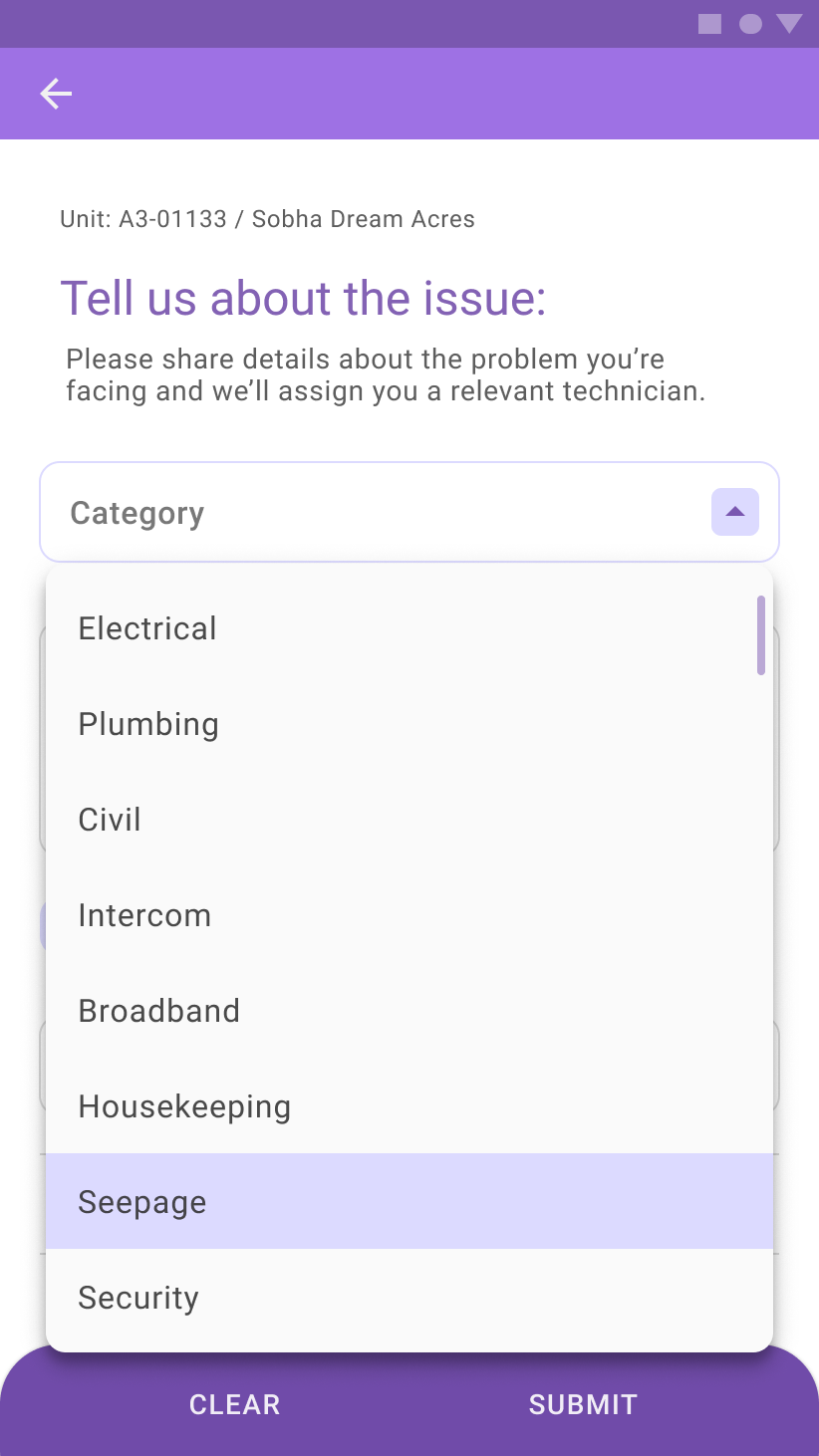
Select one of the options: For instance “Seepage”.
2/4 Adding Details
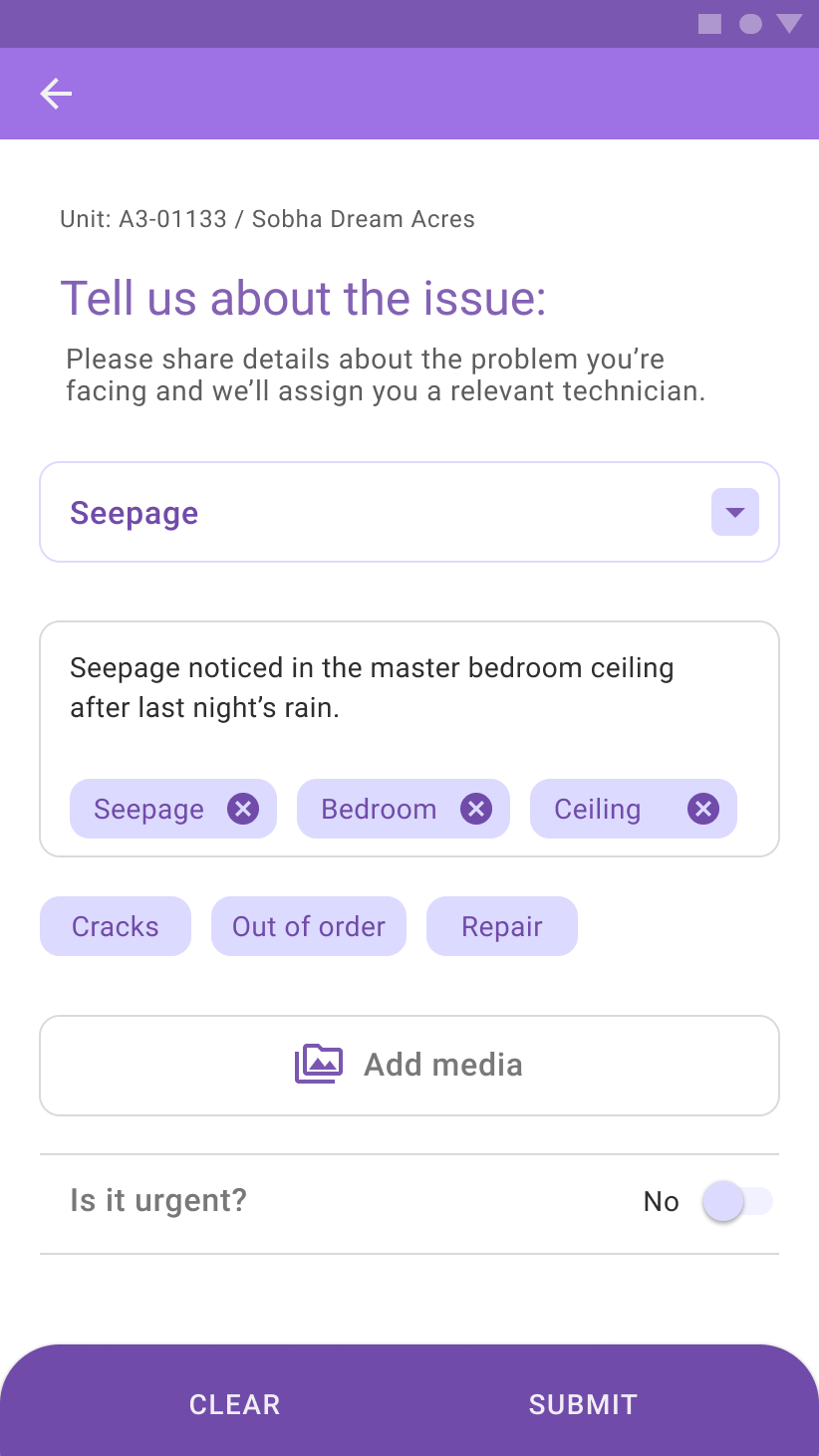
Quick Tags
This feature helps users quickly put together a sentence with all relevant details. Most tags are auto-generated based on the Category selected. The users have the option to add these tags or write a full description about the issue themselves.
Add Media
This feature triggers access to the Camera and Gallery from which the users can click a photograph or upload an existing photograph from the gallery. A photograph of the issue such as a broken pipe, cracks, seepage etc. allows the technician to come prepared with tools.
Setting Urgency
Setting the Complaint request to Urgent puts this request on top of the list in the admin’s dashboard. The technician views these requests and tends to them as priority. In the internal systems, the technician or admin can re-assign a different priority.
3/4 Tracking Resolution
-
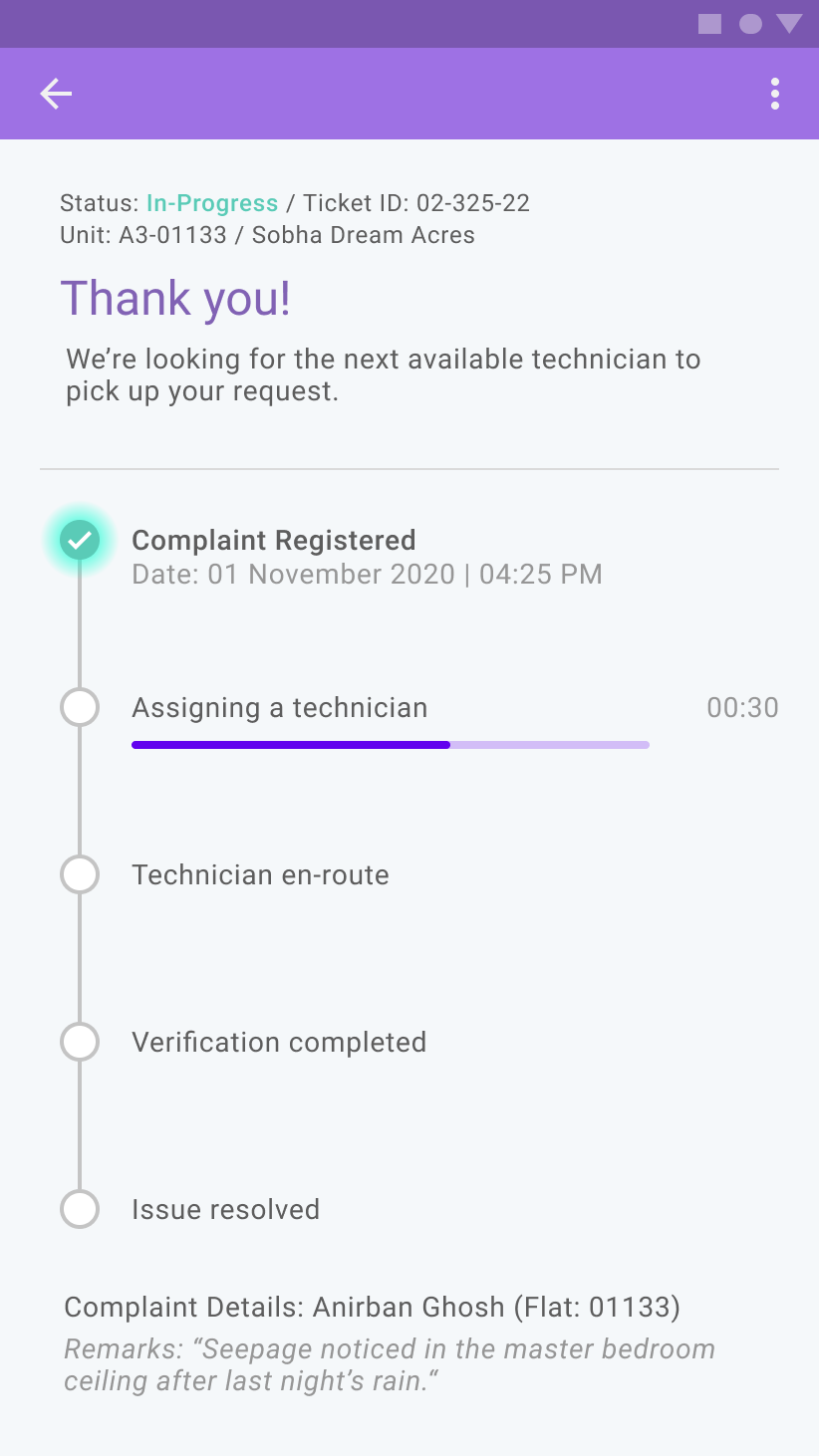
Once the complaint is registered, the technician is assigned within a designated time.
-
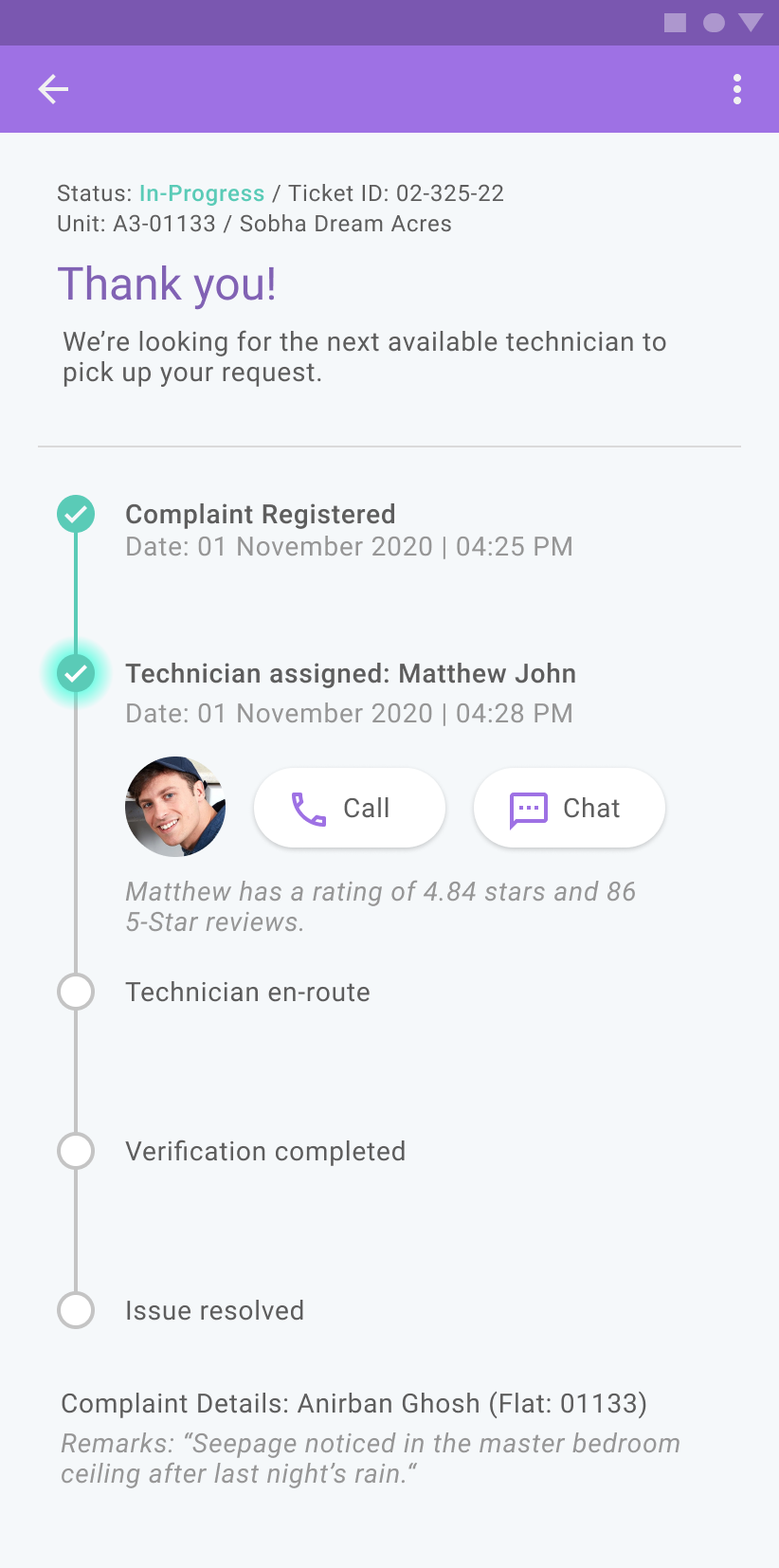
The user also has visibility to the next set of steps to be completed to resolve the issue.
-
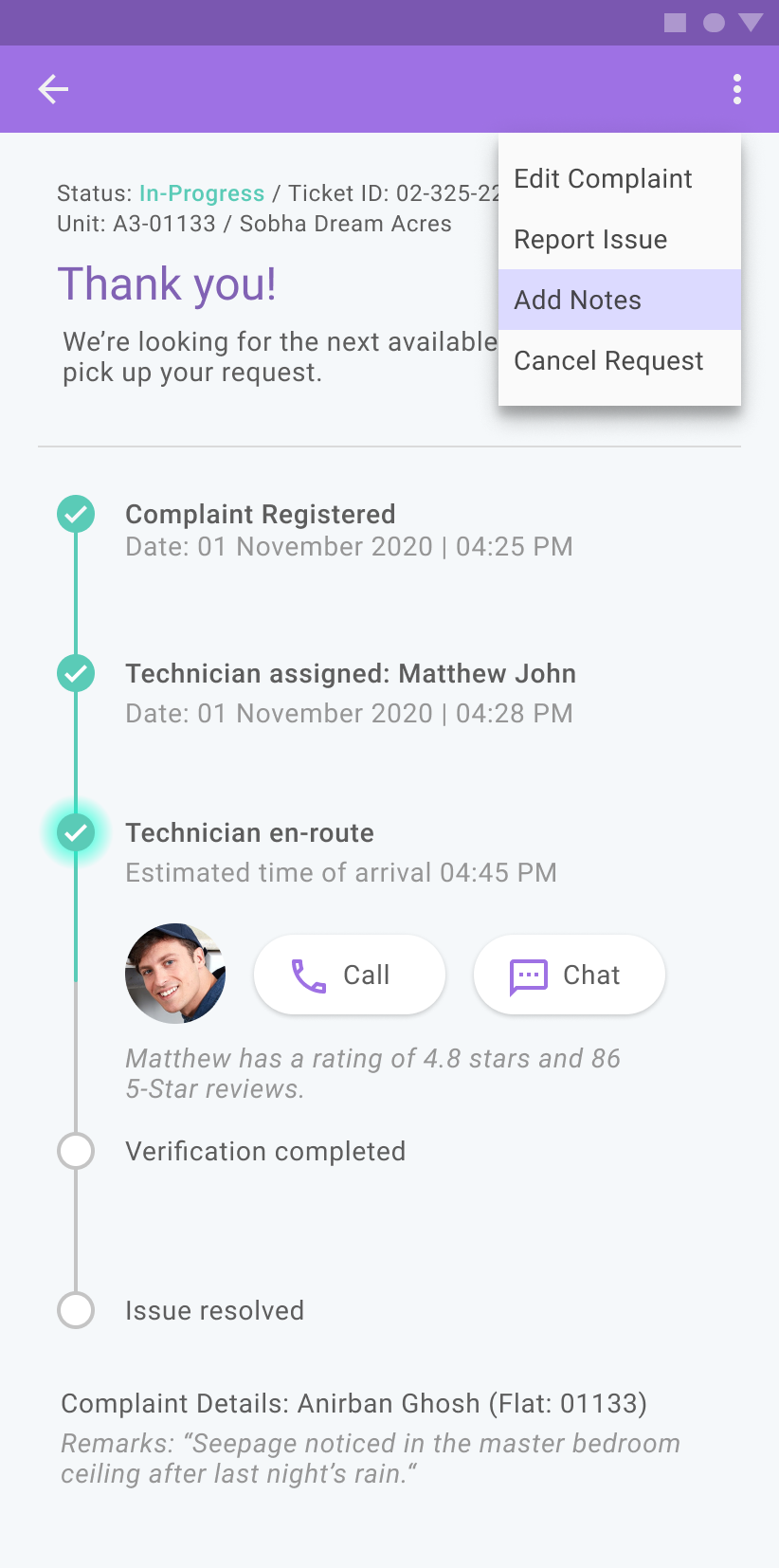
The technician’s ratings are visible. Even after the request is initiated, the user can still add notes and edit certain bits of the main request.
-
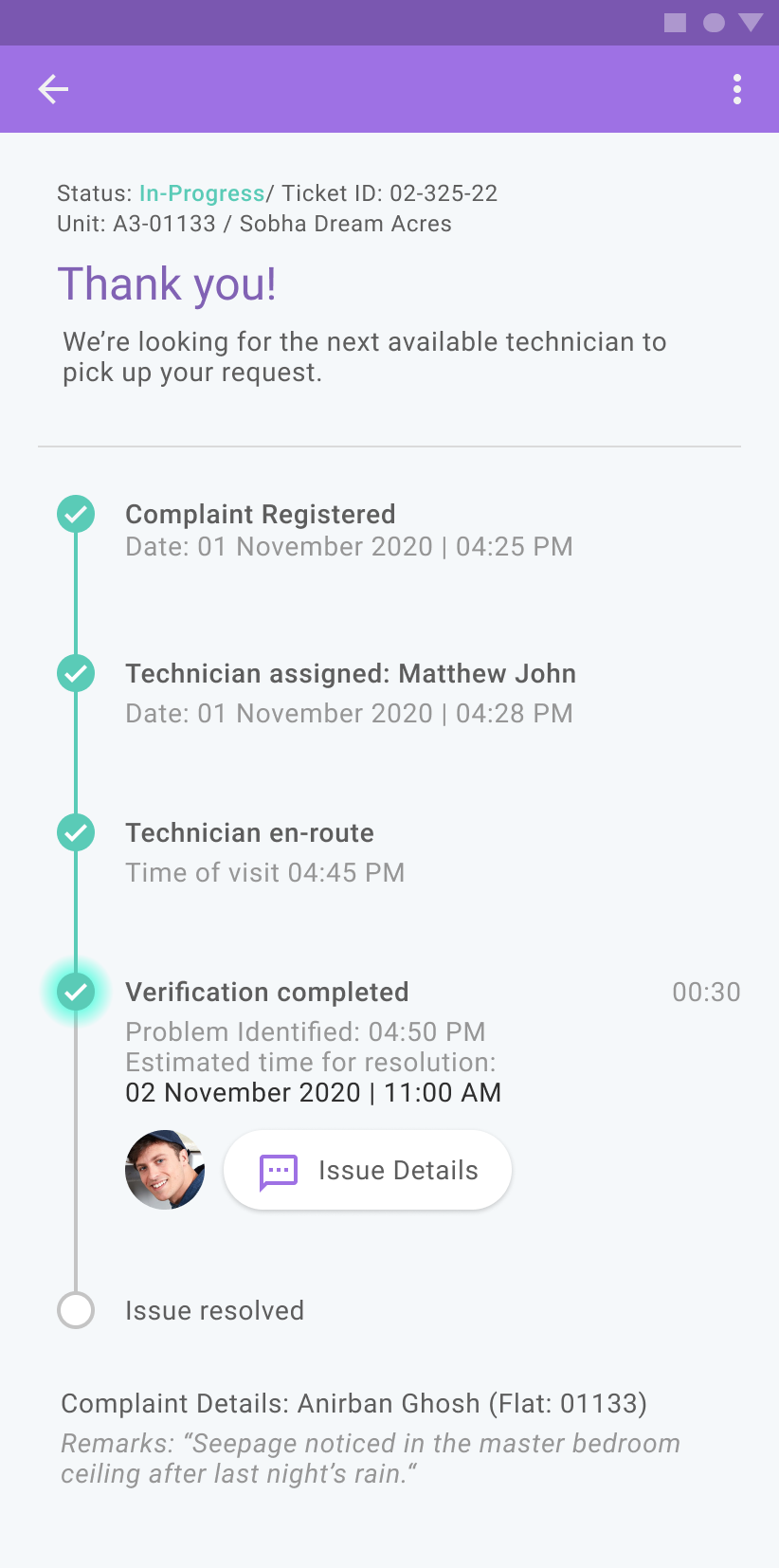
The technician adds issue details which are visible to the resident and also to the admin team. The time taken to resolve the issue is also recorded.
4/4 Feedback
-
-
-
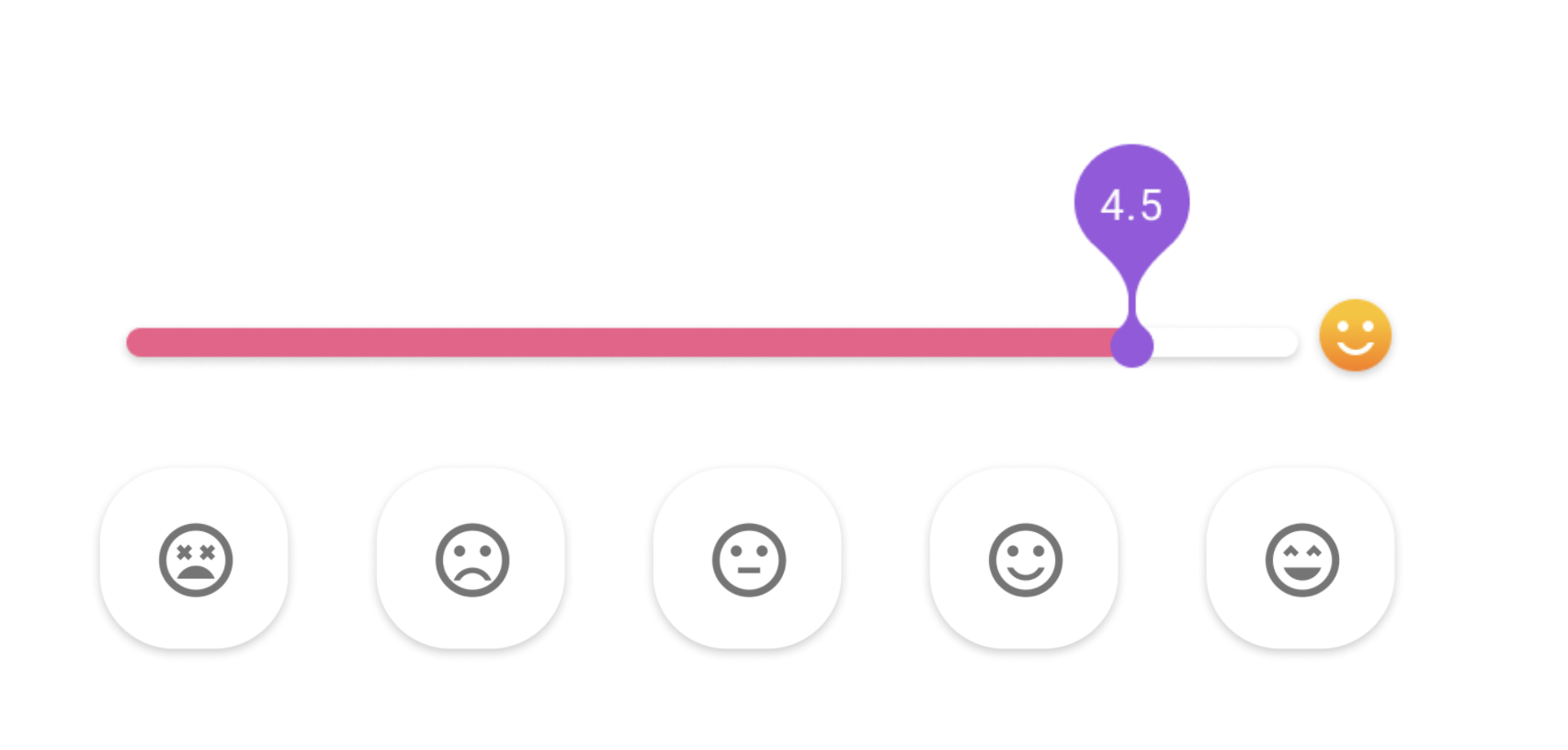
The feedback screen has a playful slider that (in addition to quantitative review) allows users to pull the button and leave a feedback visually. The emoji at the end of the slider changes from dissatisfied to very satisfied as the rating improves.
My Profile and Home Screen Scroll
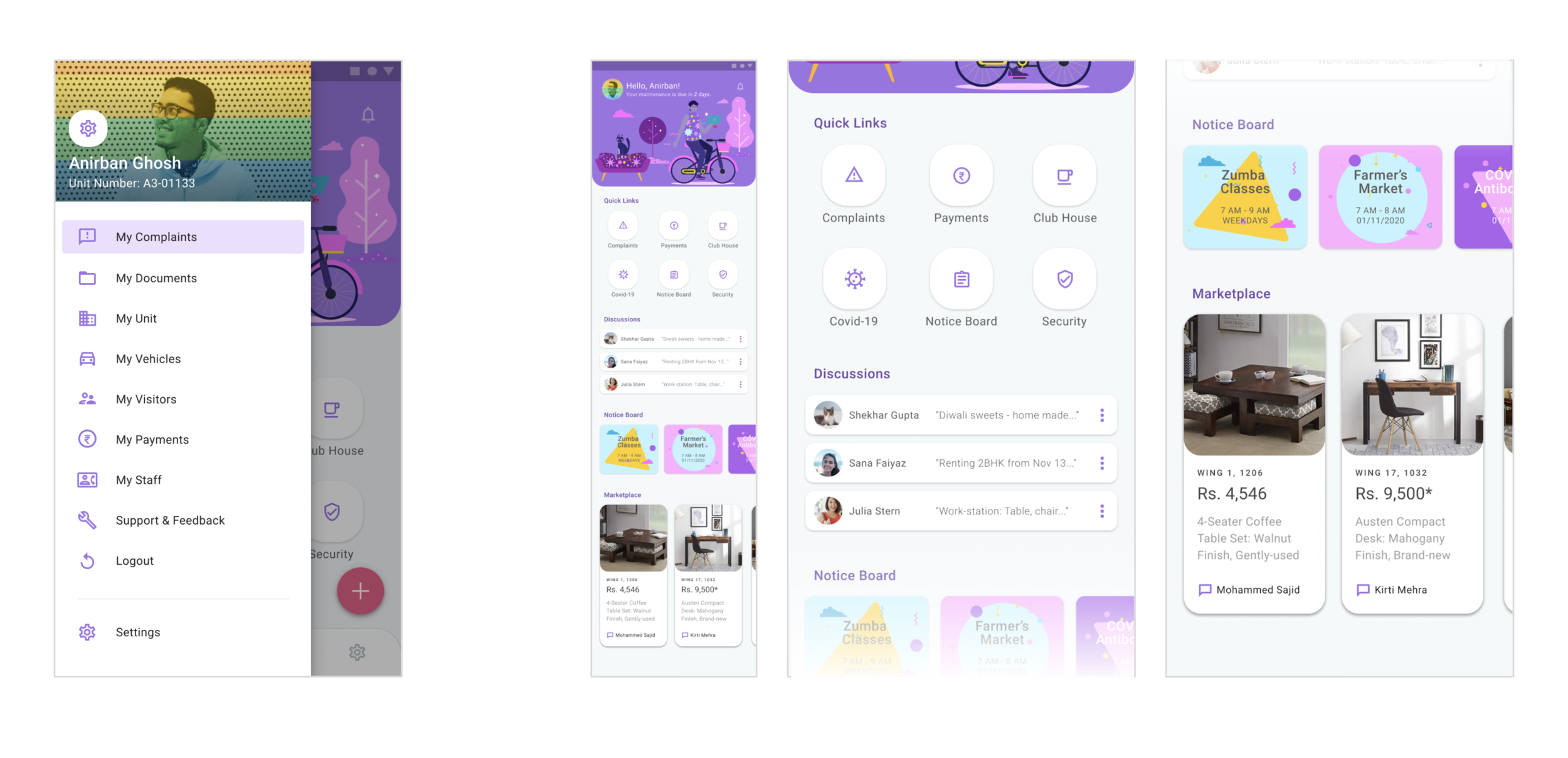
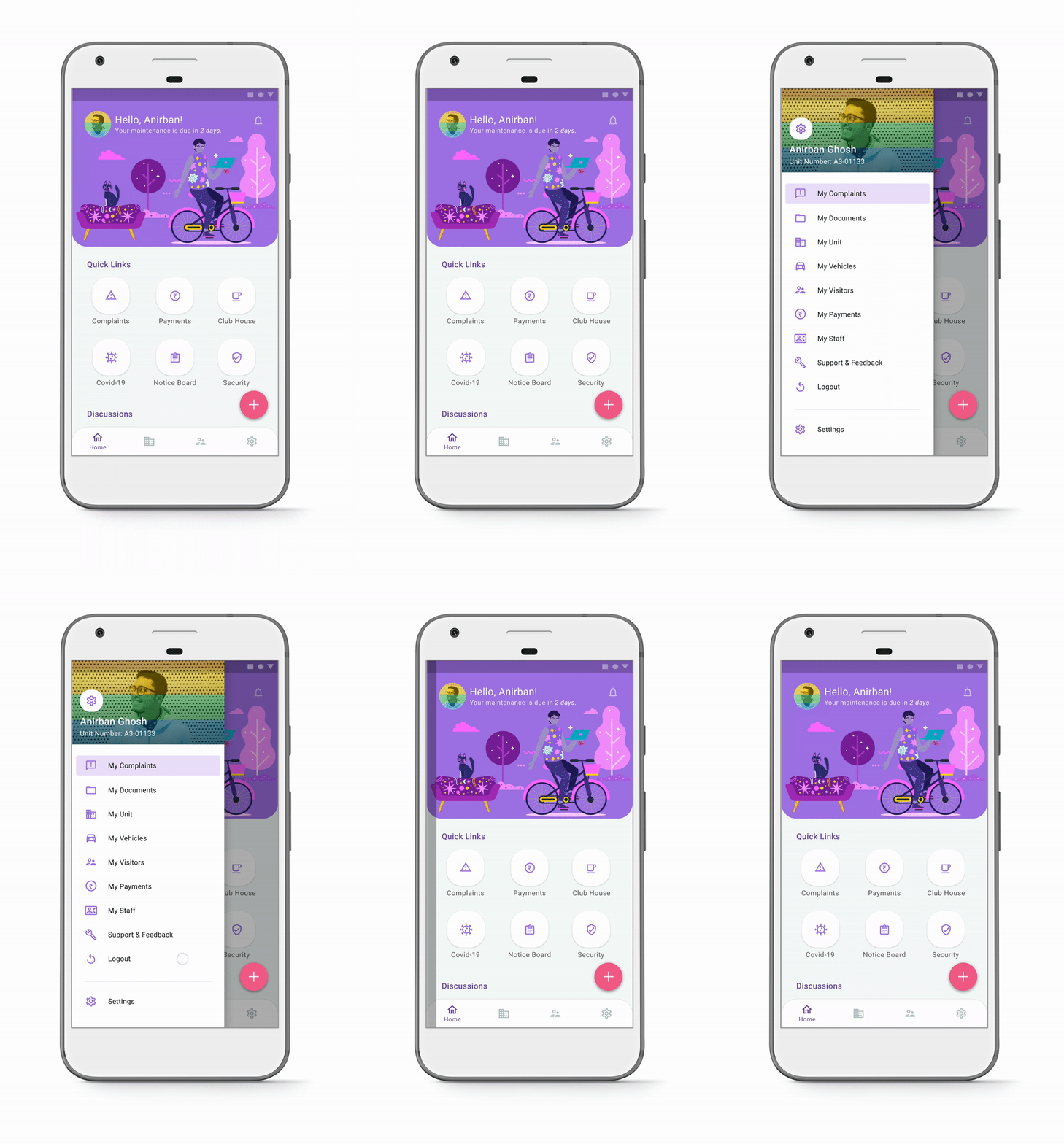
My Profile Overlay slides in from the left once the Profile IC is tapped - contains all relevant shortcuts linked to the user’s activity.
The Home Page has a long scroll with Quick Links, Discussions, Notice Board, Ads put up by other residents (Buy/Sell) and more.
Prototype
-
Reporting Issue
-
Profile
-
Tabs
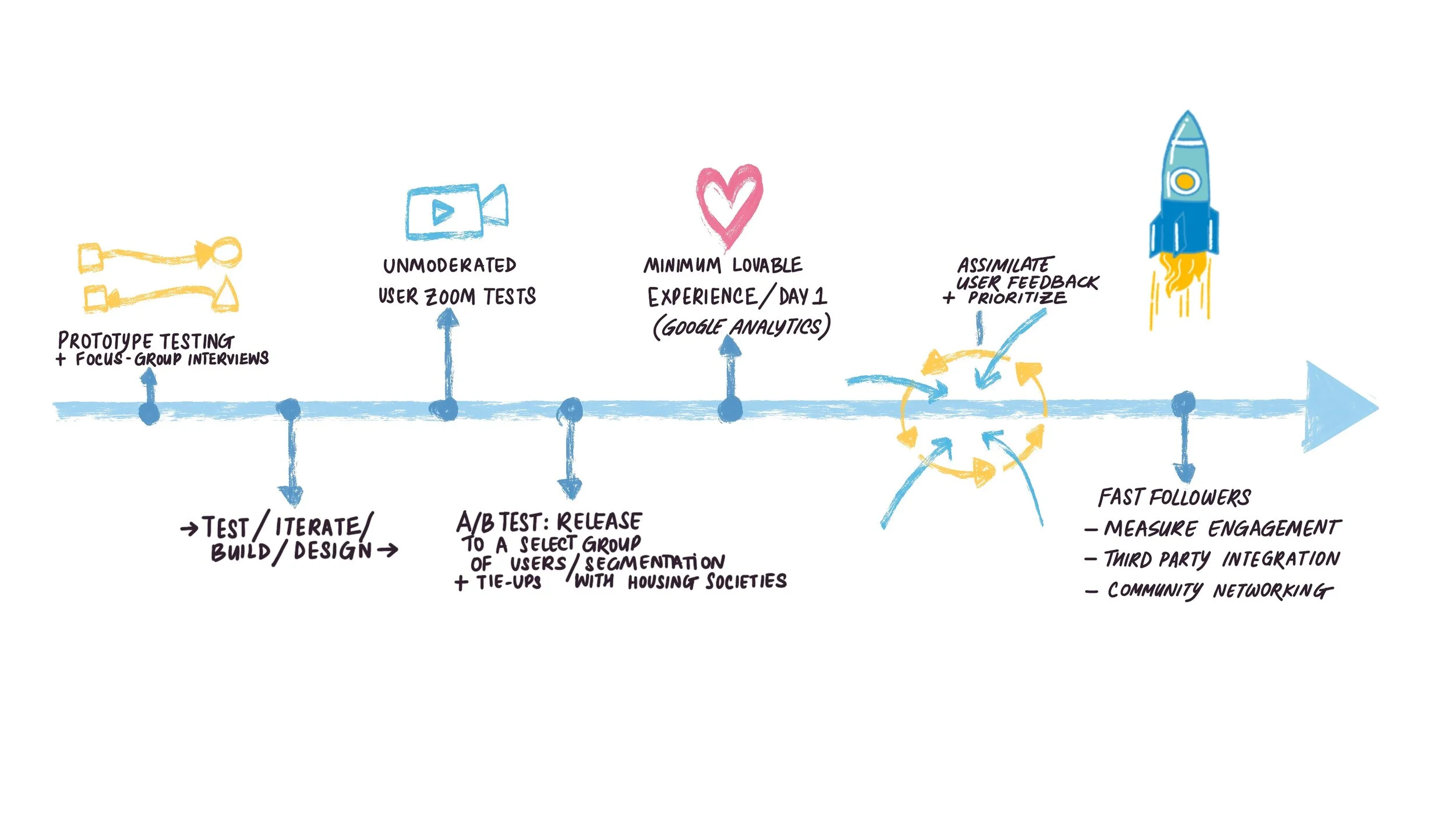
Release Roadmap
Tech Architecture
Questions for the tech architects / development team:
Will it be a Cross Platform App or native/custom-built to devices? If cross platform then how do we adapt for specific design language/experience in different OS and devices? (iOS design system etc.) What are the Pros and Cons of both?
Adding Screen Reader Headings / ADA Compliance Check for Accessibility.
Will it be a SAP based monolith or a collection of microservices?
Is there a possibility for hot-fixes regularly or should we prepare for version updates?
How do we encrypt user data securely and prepare for potential security threats and attacks?
Would these security measures impact the user experience? Should we keep any constraint in mind?
Will it useful to use a Content Management System (Contentful/Adobe Experience Manager) for easier integration and shorter release cycles?
Fast-Followers
-
Schedule Technician Visit
-

Accessibility: Add Voice Notes
-

Language Support
-

Web App
-

Community vs Persona
-

Coffee Meets
Measurability of Success
-

Adoption: Reaching target for the first #M customers
-
Time taken to resolve issues
-
Feedback: Qualitative + Quantitative
-
Engagement outside of value-based services
-
Scalability: Stress-testing / Peak traffic handling
-

New business models: Revenue via Payment gateways
Mi Casa will be considered truly successful if it:
integrates seamlessly into the day-to-day needs and life cycle of residents,
without overwhelming them with too much information (chats, forums, polls, spam emails),
yet rising to the occasion to understand what they want by studying prior usage,
by being contextual and relevant,
and by eliminating any scope for negative biases to seep in into its ecosystem.